
Seven Sundays Cereals Found to contain 223ppb of glyphosate, and the aftermath
One bag tested at 223 ppb of glyphosate. The brand's own retest came back under 10. Here is every lab number, report ID and statement from both sides.

Emily Harper

In May 2026 a single number went around the clean-food internet: 223 ppb of glyphosate in a bag of Seven Sundays sunflower cereal. The post that carried it had a real certificate of analysis attached, racked up thousands of likes, and the comments were exactly what you would expect. People had just bought a bag at Costco that morning.
Two months later Seven Sundays published their own lab reports. The same product came back at under 10 ppb, and two products nobody had tested came back dirty.
Both sets of numbers are real. This post is the whole timeline, with every ppb, every lab, every report number, and what the company actually said, so you can decide for yourself.
Test one: 223 ppb, Anresco Laboratories
The original test was commissioned by a food-scanning app and run by Anresco Laboratories, an independent San Francisco lab. The certificate of analysis they posted is specific enough to check:
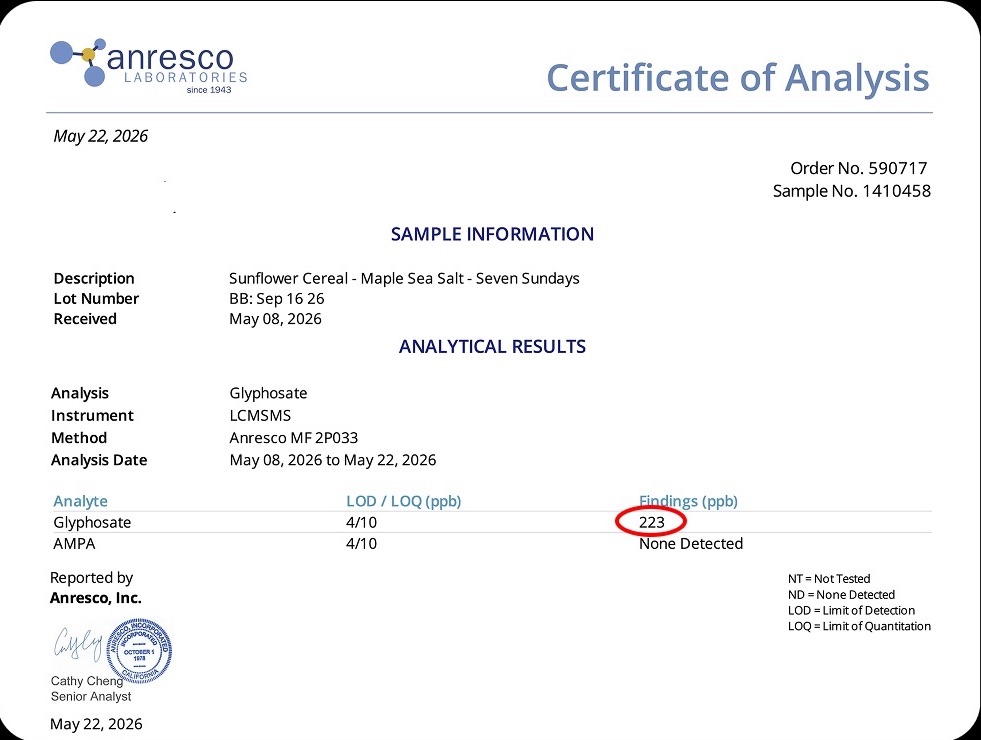
| Field | Value |
|---|---|
| Lab | Anresco Laboratories |
| Sample | Sunflower Cereal - Maple Sea Salt - Seven Sundays |
| Lot | BB: Sep 16 26 |
| Received | May 8, 2026 |
| Analysis date | May 8, 2026 |
| Method | Anresco MF 2P033, LC-MS/MS |
| Order / Sample no. | 590717 / 1410458 |
| Glyphosate LOD / LOQ | 4 ppb / 10 ppb |
| Glyphosate result | 223 ppb |
| AMPA | None detected |
| Reported | May 22, 2026 |
The claim attached to it was that Seven Sundays, sent in as the healthy alternative, "ended up having more glyphosate then all other cereals, combined," and that Cheerios came in second at 17.3 ppb.
One detail from that report that almost nobody mentioned: AMPA was not detected. AMPA is glyphosate's main environmental breakdown product, and it usually travels with glyphosate in field-applied residue. A clean glyphosate hit with no AMPA at all is not impossible, but it is the kind of thing that makes a second test worth running rather than a case closed.
Also worth knowing: the product tested is the same one Seven Sundays now sells as Real Maple Sunflower Cereal. It was branded Maple Sea Salt until a recent rename. Same cereal, same line.
What Seven Sundays said first
Before they had any of their own data, the company replied in the comments. Their reply is worth quoting at length, because how a brand talks before it has results tells you a lot:
All 23 of our grain-based cereals (Oat Protein, Crispies, PB Puffs, Protein Oats, Mueslis, Oat Granolas) are Certified Glyphosate Residue Free by The Detox Project… We've been enrolled in the certifying program since 2021 in response to the prevalent glyphosate usage in oats and other grains.
Our 5 grain free cereals (Sunflower, Grain Free Granolas) are not yet enrolled in The Detox Project's program as those ingredients were historically considered lower risk for glyphosate usage vs oats. The landscape of glyphosate has changed, it's showing up in unexpected places, and we should've included these products in our glyphosate testing program sooner. We take full accountability for that.
Because this is only 1 data point, on 1 bag, we have more testing to do before we fully understand the source and scope of the issue.
In an email sent to customers around the same time, they were blunter about the test itself: "We cannot verify the test result circulating online, simply because a single bag was tested and we were not involved in the testing, methodology, or analysis of the data."
That is a fair objection and also a convenient one. The only thing that resolves it is more testing, which is what happened next.
Test two: Seven Sundays sends five products to Eurofins
Seven Sundays sent all five of their uncertified grain-free products to Eurofins, the same lab network that runs their Detox Project certification testing, and then published the raw PDFs on their glyphosate page. Every one of the reports says the same thing on the header: samples received May 29, 2026, reported June 5, 2026, method QA748 Glyphosate by LC-MS/MS, run through Eurofins Microbiology Laboratories in Mounds View, Minnesota and subcontracted to Eurofins Central Analytical Laboratories in Louisiana.
| Product | Eurofins report | Result as reported | In ppb |
|---|---|---|---|
| Real Cocoa Sunflower Cereal | AR-26-JF-027073-01 | <0.01 mg/kg | non-detect (<10 ppb) |
| Real Berry Sunflower Cereal | AR-26-JF-027074-01 | <0.01 mg/kg | non-detect (<10 ppb) |
| Real Maple Sunflower Cereal | AR-26-JF-027076-01 | <0.01 mg/kg | non-detect (<10 ppb) |
| Day Dream Granola (dark chocolate raspberry) | AR-26-JF-027078-01 | 0.02 mg/kg | 20 ppb |
| Rise & Shine Granola (strawberry banana) | AR-26-JF-027079-01 | 0.07 mg/kg | 70 ppb |
So the flavor that tested at 223 ppb in early May tested non-detect three weeks later. And the two grain-free granolas, which nobody had accused of anything, are the products that actually have glyphosate in them.
Here is the company's own explanation, dated 06.10.26:
We tested all three flavors of our Sunflower Cereals, using the same verified laboratory that we use for The Detox Project Glyphosate Residue Free Certification, and the results came back non-detect for glyphosate (<10 parts per billion). Our grain free granolas (Day Dream and Rise & Shine) were sent into the same laboratory and came back with glyphosate residue at 20 ppb and 70 ppb, respectively. We have learned from The Detox Project this is likely in the range (<100 ppb) of "drift from neighboring farms." We have more work to do on identifying the source.
And their stance, from the letter signed by co-founders Hannah and Brady:
Glyphosate does not belong in our food system and water ways. Glyphosate usage on an increasing number of crops is a widespread and unregulated issue, and it has to change.
They also wrote, in the same letter, "Please know that all of our ingredients are grown and produced according to federal and state guidelines and safe to consume." Keep that sentence in mind for the next section, because it is true and it is doing less work than it sounds like.
Can both tests be right? Yes, and that is the actual lesson
Nothing here requires anyone to be lying.
- Different bags, different lots. Anresco tested lot BB: Sep 16 26. Seven Sundays sent whatever was current three weeks later. Pesticide residue is not evenly distributed across a production run, and a single bag is a sample size of one, in both directions.
- Different labs, different methods. Anresco ran method MF 2P033 with a 4 ppb detection limit. Eurofins ran QA748 with a 10 ppb reporting floor. Both are LC-MS/MS, which is the right instrument, but they are not the same protocol.
- A "non-detect" is not a zero. Eurofins reported <0.01 mg/kg. That means below 10 ppb. It does not mean nothing is there.
- Neither party is neutral. The 223 ppb test was paid for by an app that competes for the same shelf-scanning audience. The <10 ppb tests were paid for by the brand being accused. That is not an accusation against either one, it is just the reason you want the report numbers and the method printed on the page, which in this case you have for both.
The one thing you cannot conclude from any of it is that a single bag settles anything. We ran into the same wall writing about avocado oil, where the study bought two separate lots of everything, and products passed one lot and failed the other.
Is 70 ppb a lot?
This is where the internet loses the plot, so let me put the number in a stack.
| Reference point | Level |
|---|---|
| Quaker Oatmeal Squares Honey Nut, EWG 2018 | 2,837 ppb |
| Seven Sundays sunflower cereal, Anresco May 2026 | 223 ppb |
| EWG's health benchmark for daily consumption | 160 ppb |
| Detox Project "drift" range | under 100 ppb |
| Rise & Shine grain-free granola, Eurofins | 70 ppb |
| Day Dream grain-free granola, Eurofins | 20 ppb |
| Cheerios, Anresco May 2026 | 17.3 ppb |
| Detox Project certification floor | under 10 ppb |
| EPA legal tolerance, oilseeds group 20 (sunflower) | 40,000 ppb |
| EPA legal tolerance, cereal grains group 15 (oats) | 30,000 ppb |
Both federal tolerances come from 40 CFR 180.364. The legal ceiling on sunflower seed is roughly 570 times the level that got this brand dragged.
So "all of our ingredients are grown and produced according to federal and state guidelines" is true and nearly meaningless. Practically every oat product ever tested clears that bar, including the ones at 2,837 ppb. The bar that means something is the certification bar, and 70 ppb does not clear that one.
What I actually think of it
I want to be fair here, because a brand testing itself and publishing a result that makes it look worse is not something you see often.
What they did well. They posted the actual PDFs, not a summary. Report numbers, sample codes, method, lab, dates, all checkable, which is why every figure in this post could be verified against the source document. They used the same lab as their certification program instead of shopping for a friendlier one. They tested five products when they were only asked about one, and they published the two results that hurt them. They said "we should've included these products in our glyphosate testing program sooner" in public.
What is still open. The 20 ppb and 70 ppb granolas are on shelves right now and are not certified. "Drift from neighboring farms" is a plausible explanation from The Detox Project, not a finding, and Seven Sundays says so themselves: "We have more work to do on identifying the source." A single retest per product is still a single retest per product. And there is a small inconsistency worth noting: their public letter says they have been "voluntarily testing since 2019 and… enrolled in the certifying program since 2021," while the email their support team sent customers said enrolled "since 2019." Small, but if you are going to lead with transparency, the dates should match.
Where that leaves the shelf. The 23 grain-based products, the mueslis, oat granolas, protein oats, oat protein cereal, PB Puffs and Little Crispies, are the ones carrying Detox Project Glyphosate Residue Free certification, and that is the strongest glyphosate claim in the category. Those were never the products in question. The sunflower cereals now have one non-detect result each and no certification yet. The two grain-free granolas have a detection and a stated plan.
That is a more useful thing to know than "cereal brand caught," which is what most people took away from a screenshot.
The thing this whole story is really about
One bag got tested, and it moved a company. That is genuinely good. It is also a terrible system. Every number in this post exists because a competitor paid for one test and a brand paid for five more. No regulator ran any of it, and no rule required either party to publish anything.
That is why we built Tallow. Scan a barcode and you get what is actually in the product: every ingredient rated one by one, plus the real published lab results attached to the product when they exist, linked to the exact report they came from. So when the next 223 ppb screenshot goes around, you can go look at the document instead of the caption. Eat clean, drink clean, and make the label prove it.
This article reports publicly published third-party lab results and public statements for consumer-information purposes. Results reflect the specific lots and samples tested and are not a statement about every batch any brand produces, nor a legal determination against any company. Sources: Seven Sundays' glyphosate page and published Eurofins reports, the Anresco certificate of analysis, The Detox Project, Environmental Working Group, and 40 CFR 180.364.