
Glyphosate and Cancer rates map near identical
The CDC found glyphosate in 80% of adults and 87% of children tested. Almost none of them ever touched Roundup. Here is the spray that puts it in breakfast.

Emily Harper
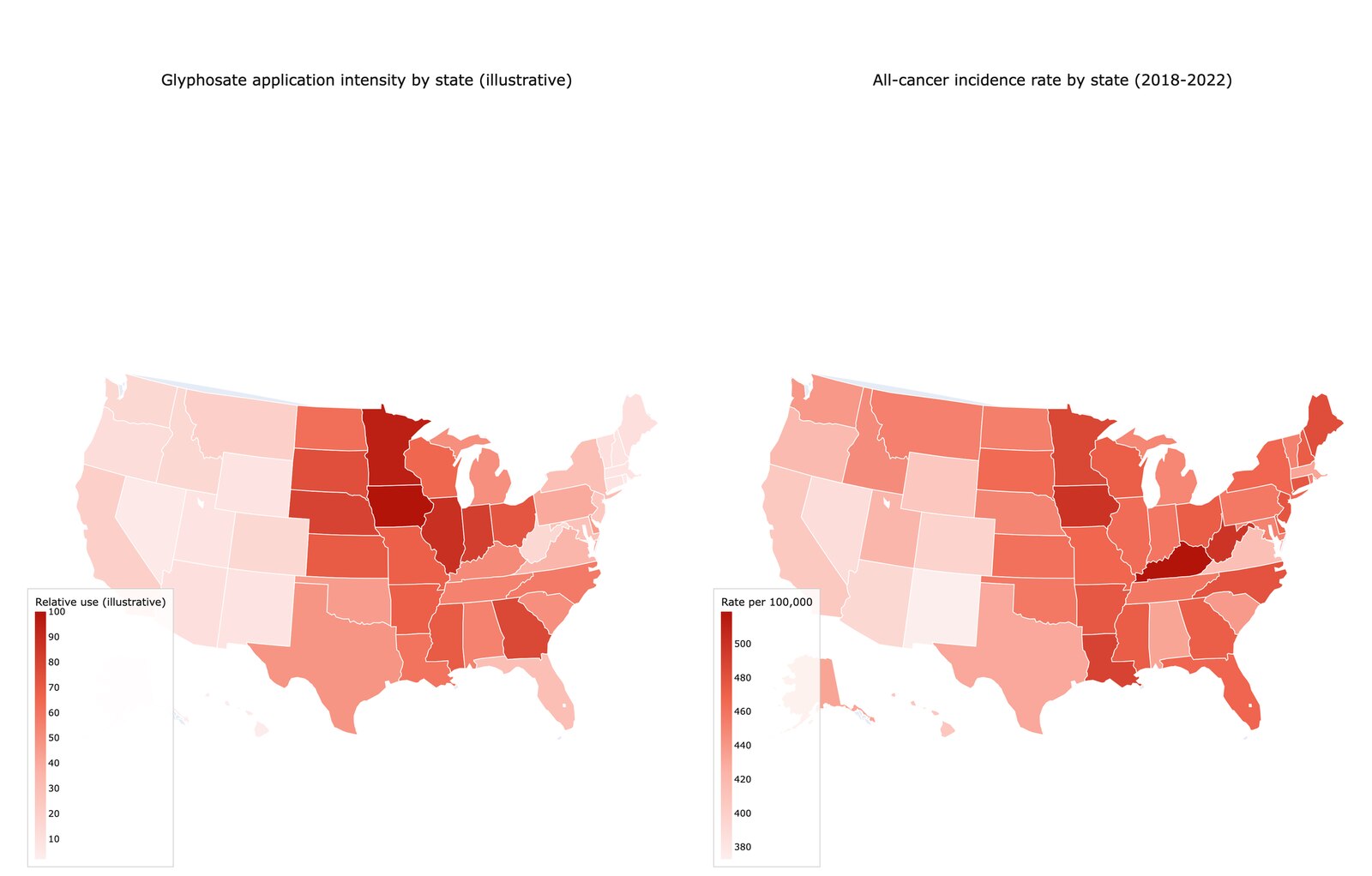
In 2022 the CDC published biomonitoring results that should have been a bigger story than they were. Out of 2,310 urine samples collected for the National Health and Nutrition Examination Survey, 1,885 came back with detectable glyphosate. That is about 80% of adults. Among the children in the sample, ages 6 to 18, it was 87%.
Almost none of those people had ever touched a bottle of Roundup. They ate breakfast.
That is the part of the glyphosate conversation that keeps getting skipped. The argument online is always about farmworkers, or lawsuits, or whether the World Health Organization is right. Meanwhile the exposure route for basically everyone reading this is food, and the mechanism by which it gets into food is boring, legal, and almost nobody knows about it. That mechanism, not the courtroom fight, is what this post is actually about.
Glyphosate is not just sprayed on weeds anymore
Glyphosate is the active ingredient in Roundup. It started as a weed killer, which is what everyone still pictures: a farmer spraying between rows of corn to kill everything that is not corn. Bayer's genetically modified seeds are built to survive it, which is how it became the most-sprayed pesticide in America. By EPA's own accounting, roughly 280 million pounds go onto about 298 million acres of US cropland every year, and 84% of that is on soy, corn and cotton.
But the use that actually matters for your kitchen is a different one. Because glyphosate is cheap, farmers started spraying it directly onto grain crops days before harvest to kill the plant and dry it down evenly. It is called pre-harvest desiccation, and it is applied to the part of the plant you eat, at the end, with no growing season left for it to break down.
Oats are the biggest culprit. Wheat, chickpeas and other legumes are on the same list. If you have ever wondered why oatmeal keeps showing up in glyphosate headlines while corn mostly does not, that is why: nobody sprays sweet corn a week before you eat it.
What that looks like in actual food
The Environmental Working Group has been buying oat products off shelves and testing them since 2018, which is more than the federal government has done. In 2018 they found glyphosate in all 28 of 28 conventional oat products they sampled, with two Quaker Oatmeal Squares samples at 2,837 ppb and 2,746 ppb.
The good news is that it has come down a lot. When EWG retested in 2022 and published in 2023, 24 samples across 14 conventional oat products, those same Quaker Oatmeal Squares came in under 500 ppb, and some samples were as low as 20 ppb. Glyphosate was still detected in every conventional sample, and just under a third were above EWG's own health benchmark, but going from ~3,000 ppb to under 500 ppb in four years is a real change. Several companies, including Kellogg's, publicly pledged to stop sourcing oats dried with pre-harvest glyphosate after those first test rounds ran.
That is the honest version of this story: public pressure worked, and the number moved. It is also proof that the number is not fixed — it depends entirely on which farm a given batch came from, which is why one bag of the same product can test clean while another tests dirty. We saw that up close when we dug into a viral 223 ppb result on a bag of Seven Sundays cereal: the brand's own retest came back under 10 ppb. Same product line, different lot, wildly different number.
The gap between "legal" and "safe" is enormous
Here is the part that surprises people. There is no missing federal limit for glyphosate in cereal. There is a limit. It is just huge.
Under 40 CFR 180.364, EPA sets glyphosate tolerances by commodity:
| What you eat | EPA tolerance | The same number in ppb |
|---|---|---|
| Cereal grains, group 15 (oats, wheat, barley) | 30 ppm | 30,000 ppb |
| Oilseeds, group 20 (sunflower, sesame, flax) | 40 ppm | 40,000 ppb |
| Dry peas | 8 ppm | 8,000 ppb |
| Quinoa, grain | 5 ppm | 5,000 ppb |
| Rice, grain | 0.1 ppm | 100 ppb |
For comparison, EWG's health benchmark, the level they consider reasonably safe for daily consumption, is 160 ppb. The federal ceiling for oats is roughly 190 times higher than that.
The oat number was not always 30 ppm either. It was 0.1 ppm in the early 1990s, went to 20 ppm in 1997 after a Monsanto petition, and to 30 ppm in 2008. The limit moved to accommodate the spraying, not the other way around.
So when a brand tells you their product is "within federal limits," that is almost always true and almost never the question you were asking.
So is it actually giving people cancer?
This is the question underneath all of it, and the honest answer is that the science is split and the data is messy — but there is one map worth looking at directly instead of taking anyone's word for it.
In March 2026, Food & Water Watch published Glyphosate Use and Cancer Clusters. They took the counties in the top 20% for glyphosate applied per square mile of cropland in 2022 and overlaid non-Hodgkin lymphoma (NHL) incidence rates from the National Cancer Institute, the cancer IARC specifically linked to glyphosate. Below is their map, exactly as published, next to the headline numbers it produced.
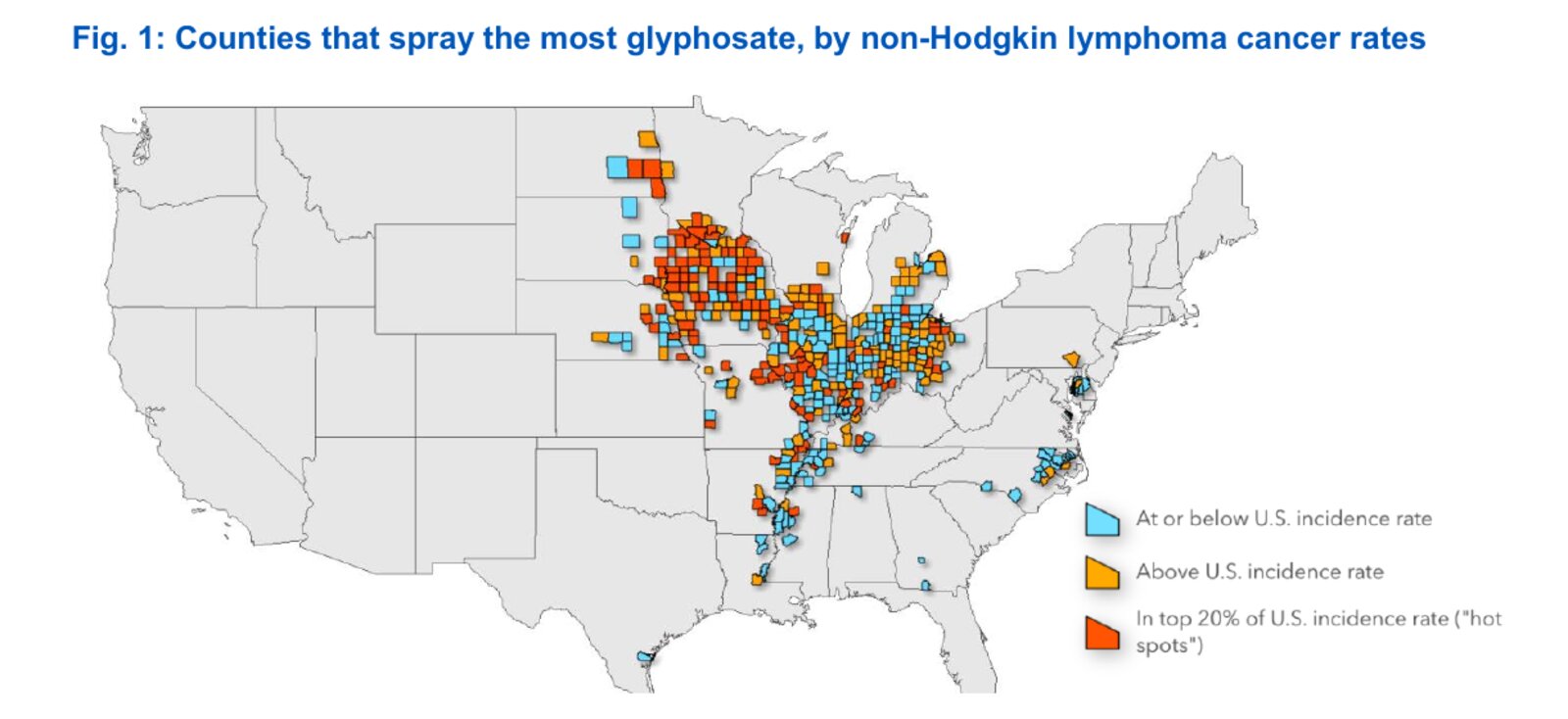 | Nationally, among the highest-spray counties: 60% have NHL rates above the US average, rising to 71% for late-stage diagnoses only. 30% are outright NHL "hot spots" — top 20% nationally. In Iowa specifically: 82% of high-spray counties have elevated NHL rates and half are hot spots; for late-stage diagnoses alone, that is 95% and 61%. |
Source: Food & Water Watch, "Glyphosate Use and Cancer Clusters," March 2026. Counties are those in the top 20% nationally for total glyphosate sprayed per square mile of cropland in 2022, with available county-level NHL incidence data. Alaska and Hawaii had no county-level NHL data.
Iowa's baseline is bad on its own, independent of glyphosate. The 2026 Cancer in Iowa report from the Iowa Cancer Registry estimates 21,700 new diagnoses and 6,400 deaths this year. Iowa has the second-highest cancer rate in the country and is one of only three states nationally where rates are still rising while the national trend falls.
Iowa is also, year after year, one of the very top glyphosate-spraying states in the country, alongside Illinois and Indiana. Conventional growers there spray it twice on the same field: once during the growing season to kill weeds between the rows of glyphosate-resistant corn and soybeans, and again right before harvest, on the crop itself, to dry it down for the combine. And it does not stay where it lands. Very fine spray droplets can drift more than 1,000 feet downwind in nothing more than a light 3 mph breeze, carrying off the field it was sprayed on and onto the next farm, the ditch, the yard, or the small town a few hundred feet past the property line — which is part of why "high spray" and "high exposure" are not the same thing as "worked directly with the chemical," and why a county-level map, not just a farm-level one, is the right way to look at this.
Now the part that gets left out of the reels built from that same map. That same 2026 Iowa Cancer Registry report featured the Agricultural Health Study, which has tracked more than 89,000 farmers, pesticide applicators and their spouses in Iowa and North Carolina since the mid-1990s. Its finding, in the registry's own words:
Iowa Farmers in the Agricultural Health Study had 13% fewer cancers overall than expected compared to the general Iowa population after adjusting for age and sex.
Spouses had 10% fewer. Farmers did have more prostate and lip cancer than expected, and spouses more melanoma and thyroid cancer, and the registry flags the "healthy worker effect" as a confound. But the people standing closest to the sprayer are not the ones with the elevated overall rate, and any honest version of this story says that out loud. Food & Water Watch's own methodology section says the same thing about its map: it is county-level exposure mapped against county-level cancer rates, correlative rather than causal, and 31% of counties had no NHL data at all.
Two well-resourced scientific bodies looked at the underlying chemical and reached opposite conclusions. IARC, the World Health Organization's cancer agency, classified glyphosate as "probably carcinogenic to humans" (Group 2A) in 2015, specifically citing NHL. EFSA, the EU's food safety authority, found "no critical areas of concern" in its 2023 review and the EU renewed approval that November. EPA has repeatedly concluded it is not likely to cause cancer, though in 2022 the Ninth Circuit vacated the human-health portion of that finding. Part of the split is definitional: IARC assesses hazard (could this cause cancer under some exposure), the food-safety agencies assess risk (will it, at the doses people actually get). Both can be technically right and the public still gets two headlines that flatly contradict each other.
What is not split is which direction the legal and political system moved this year. On June 25, 2026, the Supreme Court ruled 7-2 in Monsanto v. Durnell that federal pesticide law preempts state failure-to-warn claims where EPA's label does not require a cancer warning, reversing a $1.25 million verdict (Bayer had already paid out around $11 billion over Roundup claims). On February 18, 2026, an executive order invoked the Defense Production Act to secure domestic supply of glyphosate, directing agencies not to endanger the viability of domestic producers. Whatever you personally conclude from the map above, the supply is being protected and the warning-label lawsuits just got a lot harder. Nobody is coming to fix this for you in the next few years.
What I actually do about it
Not "stop eating grain." That is not the takeaway and it is not achievable. The takeaway is that the exposure is concentrated in a small number of foods for a specific, knowable reason, and that is a solvable shopping problem.
Know which foods are the pre-harvest-spray foods. Oats, wheat, barley, chickpeas, lentils, dry peas. Those are the ones where glyphosate goes on the edible part right before harvest. Rice, tree nuts and most fruit have tolerances 100 to 300 times lower for a reason.
Organic reduces it, and does not zero it. Glyphosate drifts from neighboring fields and moves in water. EWG's testing keeps finding low-level detections in organic oat products, which is consistent with drift rather than spraying. Organic is a real improvement in the odds, not a guarantee.
Look for Glyphosate Residue Free certification, not "third-party tested." The Detox Project's certification requires LC-MS/MS testing at an ISO 17025 lab, down to a detection limit of about 0.01 ppm, which is 10 ppb. It also covers AMPA, glyphosate's breakdown product. By one certified brand's own count, fewer than 200 companies have any product carrying it, which tells you both how meaningful the seal is and how few brands are willing to go get it.
Ask for the actual lab report. Not the claim. The PDF, with the method, the detection limit, and the number. Brands that really test will send it, and brands that publish it without being asked are the ones worth your money.
Why we built the app for exactly this
A label cannot tell you this. "Non-GMO," "natural," and "made with whole grains" are all compatible with a pre-harvest glyphosate application, because the spray happens on a farm two supply-chain steps before anybody prints a box. And as the Seven Sundays case above shows, even a brand's own good number from last quarter does not guarantee the bag on your shelf today — glyphosate residue is a lot-by-lot fact, not a brand-wide one.
That is what Tallow is for. Scan a barcode and you get what is actually in the product: every ingredient rated one by one, plus the real published lab results attached to the product when they exist, in ppb, with the method and the detection limit, linked straight to the report they came from. Not "glyphosate-free" as a marketing word — the number, the lab, and the date, so you can see for yourself whether a product is 20 ppb or 2,000. Eat clean, drink clean, and make the label prove it.
This article summarizes publicly available government data, peer-reviewed classifications, and published third-party testing for consumer-information purposes. It is not medical advice and is not a legal determination about any product or company. Sources: CDC / NHANES via The New Lede, Environmental Working Group, 40 CFR 180.364, Food & Water Watch, Iowa Cancer Registry / University of Iowa, PBS NewsHour, Iowa Capital Dispatch, Investigate Midwest, Virginia Tech Extension, Supreme Court of the United States, The White House, C&EN, and The Detox Project.