
Exposr ("Expose" app) review: free, accurate, safe?
Reviewers say Exposr won't scan without a trial, and its heavy-metal card is a risk estimate, not a test of your product. Cost, owner, free alternative.

Maddox Schmidlkofer
If you've seen a video of Neapolitan ice cream sitting under a running tap and refusing to melt, you've probably seen Exposr. Its Instagram reels regularly pass a million views, and the app has climbed to about 5,600 App Store ratings in just over a year. A lot of people call it the "Expose app", and they usually want to know three things: is it accurate, is it safe, and is it free?
I went through Exposr's App Store listing, its own screenshots, its privacy policy and its reviews. Here's what I found, including the price, which its website doesn't mention. The short version: Exposr isn't really free. Its listing says unlimited scanning needs a subscription, and recent reviewers say the app wouldn't let them scan anything until they started a trial. That's the biggest difference from Tallow, which has a free version you can keep using with no trial and no card.
(Disclosure: I'm Maddox. I studied computer science, and I build Tallow myself. Tallow is a food scanner too, so I've stuck to Exposr's own listing, screenshots and policies, and I've marked anything that comes from its App Store reviews instead.)
What is the Exposr app?
Exposr - Food Product Scanner scans a barcode or label and gives a health score, with flags for additives, seed oils and artificial ingredients. Newer versions add "Heavy Metal Risk" and "Microplastic Risk" ratings, a glyphosate flag and a "Lab Findings" section. On November 15, 2026 the App Store showed:
| Exposr | |
|---|---|
| Rating | 4.7 from about 5,600 ratings |
| Chart position | Top 100 in Health & Fitness |
| First released | October 6, 2025 |
| Platforms | Apple App Store only, no Android |
| Free to use? | Not really. The listing ties unlimited scanning to a subscription, and recent reviewers say they couldn't scan without a trial |
| Seller | Nagia LLC |
There's no Exposr on Android. Searching "Exposr" on Google Play turns up other companies' scanners instead, so check the developer name before you install anything.
Is Exposr free?
Not really. The listing says a subscription is required for "full features," including unlimited scanning, and recent reviewers say there's no free mode at all: after the setup questions, they had to start a trial before they could scan. The App Store lists these in-app purchases:
| Plan | Price |
|---|---|
| Weekly Premium | $4.99 |
| Monthly Premium | $9.99 |
| Annual Premium | $29.99 to $49.99 |
| "One-Time Offer" | $14.99 |
| "Gift Offer" | $19.99 |
Trial lengths in reviews range from 3 days to two weeks, so you may see different offers. The terms say the trial length and price are shown before you confirm, and the paid plan starts when the trial ends unless you cancel. As with any App Store subscription, deleting your account doesn't cancel it, so cancel in your phone's subscription settings. Several one-star reviews come from people who say they were charged for a full year after starting a trial.
Tallow works the other way. It shows a Premium offer after setup too, and Premium has its own trial that renews like any subscription, but you never need it: close the offer and keep using the free version for good, with no trial and no card. Free covers unlimited scanning, every ingredient rated in plain English, a thumbs up or down against the standards you pick (seed oils, additives, allergens, vegan, halal, pregnancy and more), lab results on tested products, nutrition facts, and the restaurant and Farms maps.
In the app, Premium mainly adds the 0–100 score, product search and healthier swaps. On the website, product scores are free to look up at tallow.app/products, with no app or account.
Is Exposr accurate?
Exposr's listing says it analyzes additives, seed oils and artificial ingredients, and any scanner can read those off the ingredient list. The harder question is the heavy metals, microplastics and glyphosate, because those can't be read off a label. Exposr's own App Store screenshots show how it handles them:
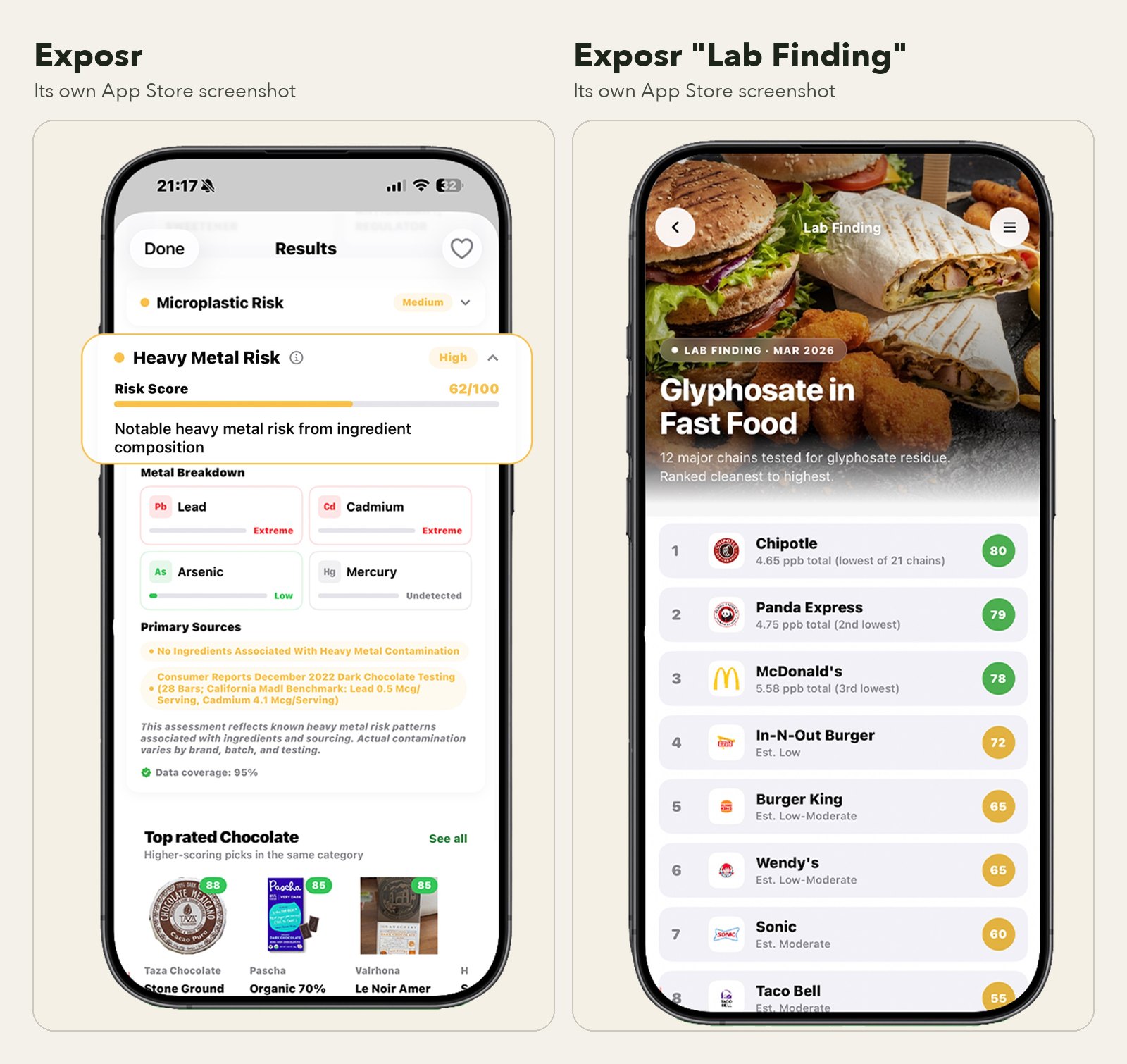
Both images are Exposr's own App Store screenshots, November 15, 2026.
- The heavy-metal card is an estimate, not a test of your product. It rates the scanned chocolate "High" (62/100) for "Notable heavy metal risk from ingredient composition," and marks lead and cadmium "Extreme." Under "Primary Sources," one line reads "No Ingredients Associated With Heavy Metal Contamination." The other cites Consumer Reports' December 2022 test of 28 dark chocolate bars. Its only numbers (0.5 mcg lead and 4.1 mcg cadmium per serving) are the California Prop 65 benchmarks Consumer Reports compared those bars against. Neither line is a measurement of the chocolate being scored. The fine print at the bottom says so: "This assessment reflects known heavy metal risk patterns associated with ingredients and sourcing. Actual contamination varies by brand, batch, and testing."
- The "Lab Finding" mixes test results with estimates. The fast-food glyphosate ranking says "12 major chains tested." The top three show measured numbers (Chipotle 4.65 ppb). From In-N-Out down, the visible rows say "Est. Low," "Est. Low-Moderate" or "Est. Moderate" instead of a measurement, and still get a score.
- The wording has become more careful. The October 2025 update that launched "Microplastics Detection" said the app "identifies plastic particles and their health impact." The December 2025 update that added heavy-metal detection talks about "potential heavy metal concerns" and "microplastic risks," and the result card now reads "Microplastic Risk." That newer wording is the accurate one: these are estimates, not measurements of the product you scanned.
None of that makes the app useless. A "this category tends to carry lead" warning can be a good nudge. The card does say its overall score comes from "ingredient composition." But the red "Extreme" labels next to lead and cadmium, sitting above a Consumer Reports citation, are easy to read as a test result for that chocolate, and the line saying actual contamination "varies by brand, batch, and testing" is in small italics at the bottom.
Some reviewers earlier this year also questioned how Exposr labels ingredients. One said Hershey's chocolate and regular potato chips were marked "mostly natural" while their "actually clean ingredient" crackers scored badly. Another said the same ingredient, organic cane sugar, was called processed in one product and natural in another.
Is Exposr safe?
It's a real app on the App Store, from a registered company, and nothing suggests it's malware. The thing to watch is billing. About two-thirds of the one-star reviews in Apple's public feed are about the paywall, the price or billing, not the scanner. If you start a trial, set a reminder for the day before it ends.
Who owns Exposr?
Exposr doesn't make this easy. It isn't hidden, and you can work it out if you dig through enough pages and profiles, but the website doesn't just tell you. There's no About or team page: apart from the App Store and its social accounts, its homepage links only to a privacy policy, terms and a support email. The privacy policy says only that Exposr is "operated by NAGIA LLC, a Wyoming limited liability company," and nowhere does the site name a founder or the people who run it.
You don't have to know a founder's name to use an app. But Exposr is asking for $30 to $50 a year to tell you what's in your food, and you shouldn't have to play detective to find out who's behind it. Tallow's About page is a signed letter from me, Maddox Schmidlkofer, with my photo. It explains why I built Tallow and why the main features stay free, and it gives the support email I answer. I write the scoring and the scanner, so if a score looks wrong, your email comes straight to me.
Where Tallow is different
- A free version you can actually use. Scanning, ingredient ratings, lab results, the restaurant map and the Farms map are free, with no trial, no card and no scan limit. Premium is optional.
- A founder you can look up. A real name and photo on the About page, not just an LLC in the privacy policy.
- Measured lab results, with the source. When a product has been tested, Tallow shows the measured numbers and links the report, not a risk rating estimated from the ingredient list. If only a product with the same brand and base recipe was tested, it says "Family Tested," names that product and tells you yours wasn't tested itself. (Here's where our lab data comes from.)
- It's on Android too.
Common questions
Is the "Expose app" the same as Exposr? If you mean the food scanner, yes. It's spelled Exposr ("Exposr - Food Product Scanner" on the App Store, sold by Nagia LLC). On the App Store, searching "Expose app" mostly brings up unrelated "Exposed" party games, so look for the name Exposr and the seller Nagia LLC.
Is Exposr free? Not really. It's free to download, but the listing says unlimited scanning needs a subscription, and recent reviewers say they couldn't scan without starting a trial. On November 15, 2026 the plans were $4.99 a week, $9.99 a month or $29.99 to $49.99 a year.
Is Exposr accurate? Its additive and seed-oil flags are the kind any scanner can read off the label. Its heavy-metal card says in the fine print that it reflects "risk patterns associated with ingredients and sourcing," not a lab test of the product you scan, and its microplastic result is shown as a "risk" level too.
Is Exposr safe? It's a real App Store app from a registered company, Nagia LLC, and nothing suggests it's malware. The main thing to watch is the trial: if you don't want to pay, cancel in your phone's subscription settings at least a day before it ends, because Apple can charge for renewal in the last 24 hours.
Is Exposr on Android? No, it's only on Apple's App Store. If you're on Android, Tallow is on Google Play.
Who makes Exposr? Nagia LLC, a Wyoming company, according to Exposr's terms. The website has no About or team page, so finding the people behind it takes some digging.
Want to know what was actually measured?
Exposr's own screenshot says it plainly: its heavy-metal rating reflects "risk patterns associated with ingredients and sourcing," and the card shows no lab result for the chocolate it scanned. What you actually want to know is whether that chocolate tested clean. Get Tallow free and scan the chocolate, protein powder or baby snack you're worried about. If it has been lab tested, or a product with the same brand and base recipe has, you'll see the measured numbers, which product they came from and a link to the report. Either way, the seed oils and additives on the label get flagged in plain English.
Method: App Store details, in-app purchases, release notes and reviews are from Exposr's US App Store listing and Apple's public review feed on November 15, 2026. Screenshots are Exposr's own App Store images. Ownership details are from exposr.app, its privacy policy and terms (updated November 9, 2026). I didn't install Exposr for this review, so everything about its paywall and scanning comes from its listing, terms and reviews.