
Where food scanner apps get their lab results, and how to read one
Two apps read the same lab report on a tea and scored it 83 and 4. Here's who actually pays for food lab tests, and six questions to ask of any Lab Tested badge.

Maddox Schmidlkofer
I scanned one box of Traditional Medicinals Organic Roasted Dandelion Root tea in three food scanner apps on the same afternoon. Yuka scored it 100. Oasis scored it 83. Tallow scored it 4.
Two of those apps were looking at the same lab report. One of them wasn't looking at any.
"Lab tested" has become the selling point of the food scanner category, and it means wildly different things depending on the app. This guide explains where the lab numbers in these apps actually come from, why the same report can produce opposite scores, and how to read one yourself, so you're never just trusting a badge.
(Disclosure: I build Tallow, one of the apps in this comparison. Everything below that's about Tallow is checkable in the app, and I've tried to be as hard on us as on anyone else.)
Three kinds of "lab tested" scanner
1. Label-only apps. Yuka and Bobby Approved score what's printed on the package: nutrition facts and ingredients. That's useful, but heavy metals, pesticide residues, PFAS and plastic chemicals are never printed on a label, so these apps can't see them. Yuka's perfect 100 for the dandelion tea is a perfect score for its label.
2. Apps that run their own tests. Oasis sends products to labs itself, and those results show up in the app as "Oasis Tested." Paying for your own testing is expensive and genuinely valuable; it's how products nobody else cared about get measured.
3. Apps that collect published reports. Most of the lab data in the world was paid for by someone else: independent testers, consumer groups, universities, state health departments and brands publishing their own certificates of analysis. Apps in this group gather those reports and attach them to products. Tallow is in this group, and so is a lot of what Oasis shows.
Plenty of apps also do a fourth thing: they show a "contaminant risk" or "heavy metal" flag that wasn't measured on that product at all, inferred from the category or an ingredient. Some label those flags clearly, some don't. If an app can't show you a report, assume it's an estimate.
Who actually pays for food lab tests
Here's where the 987 lab reports in Tallow's database came from, as of October 1, 2026:
| Who ordered the test | Reports |
|---|---|
| Lead Safe Mama (Tamara Rubin, independent consumer advocate) | 454 |
| Oasis (the app's own testing program) | 333 |
| PlasticList (plastic chemicals in food) | 87 |
| The brand itself (published certificates of analysis) | 71 |
| Universities, nonprofits and state programs | 36 |
| Consumer Reports | 3 |
| Mamavation | 3 |
A few things jump out:
- One person is behind nearly half of it. Tamara Rubin has been sending consumer products to accredited labs for years and publishing every result. A huge share of the heavy-metal data anyone has on everyday groceries traces back to her.
- A competitor's testing is in our database. A third of our reports are Oasis's tests. We credit them by name on every product they apply to, because they paid for the test and you deserve to know that.
- Brands test themselves. A brand's own certificate of analysis can be completely legitimate, but it's the brand choosing which batch to test and which results to publish. Who ordered the test is part of what the number means.
Why the source matters as much as the number
The same lead reading means something different depending on the answers to four questions:
- Who paid? An independent tester, a consumer group, a competitor or the brand.
- Which lab, which method? A named, accredited lab using a standard method such as ICP-MS for metals is a different thing from "testing" with no lab named.
- How many samples, and when? One box tested in 2024 tells you about that box. Brands change suppliers and packaging; Kerrygold changed its butter wrapper after a PFAS test.
- Can you read the original? If the app can't link the report, you can't check any of the above.
This is the one place where the apps differ most, and it's easy to check yourself.
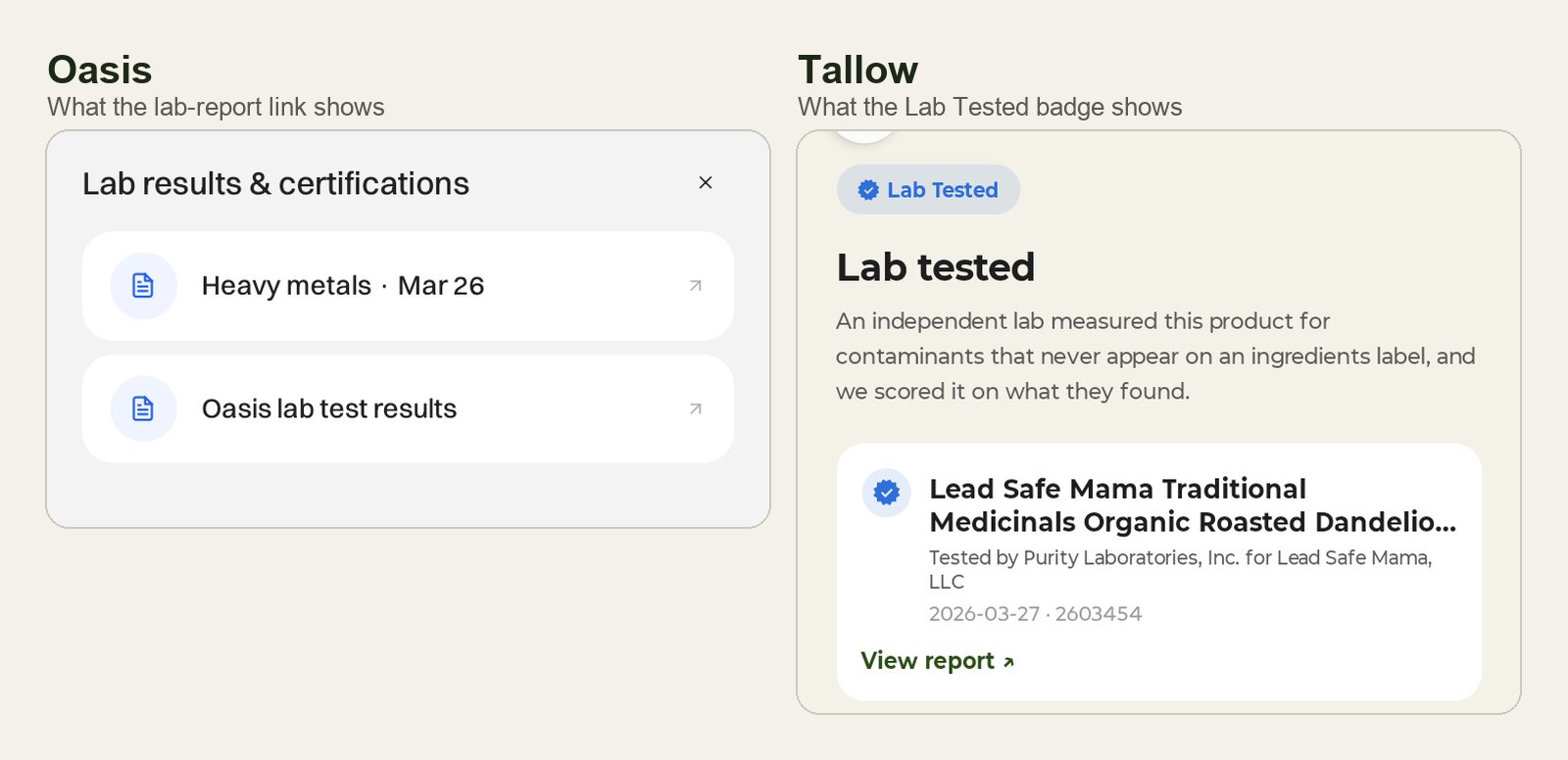
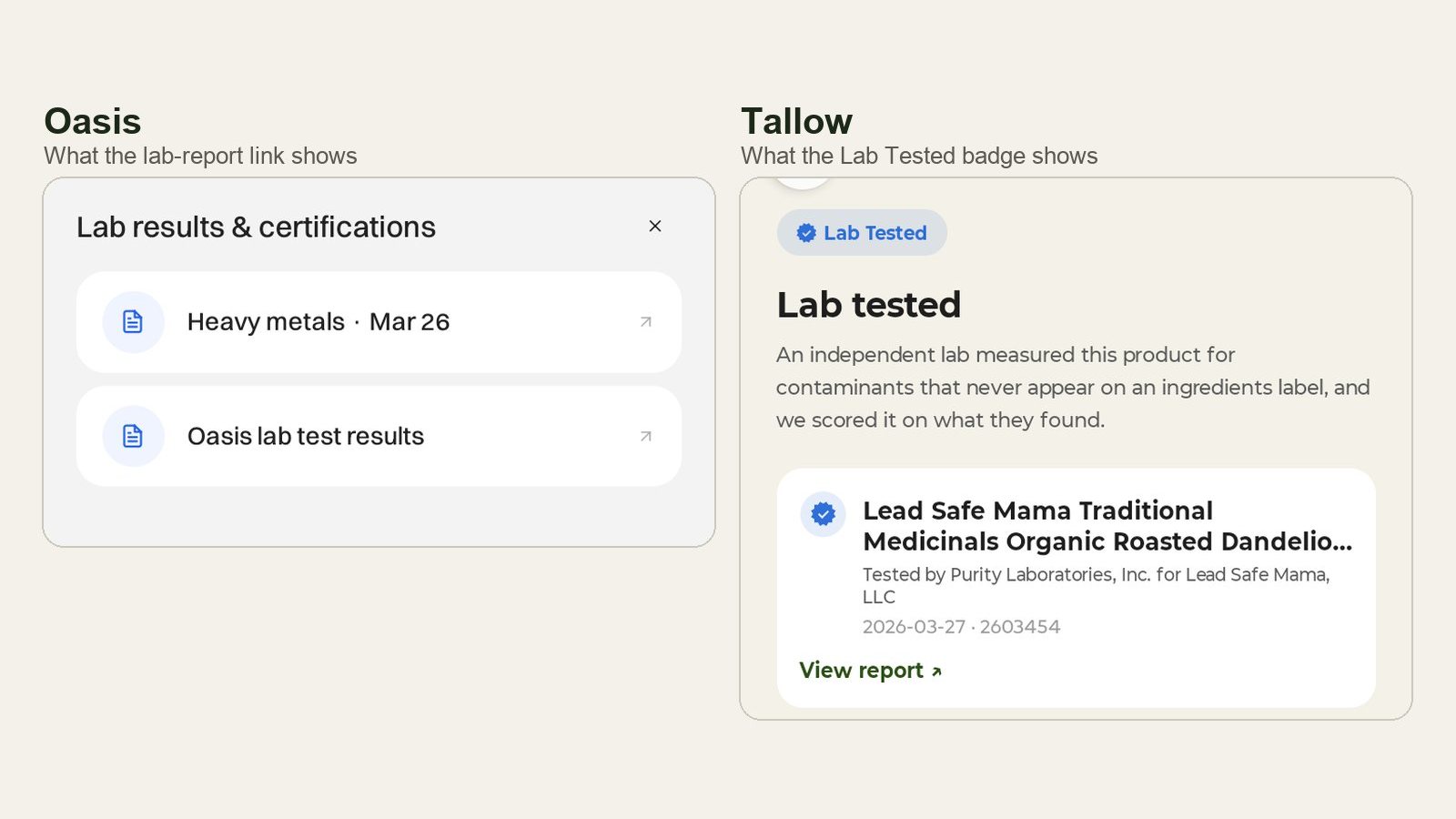
Left: Oasis's "Lab results" screen for the tea. Right: Tallow's lab sheet for the same tea.
For the dandelion tea, Oasis's lab results screen shows "Heavy metals · Mar 26," and the report page it links to calls it a "verified third-party lab report." Neither the app screen nor that page says who ordered the test or which lab ran it. Tallow's sheet for the same product reads: Lead Safe Mama Traditional Medicinals Organic Roasted Dandelion Root Tea Heavy Metals Test, tested by Purity Laboratories, Inc. for Lead Safe Mama, LLC, March 27, 2026, with a link to the original report. It's the same test with the same numbers. Only one of the two tells you whose test it is. (The tea's full results on Tallow.)
How to read a food lab report
Units: ppb, ppm and per serving
Most heavy-metal results are reported in ppb (parts per billion), which for a solid food means micrograms per kilogram (µg/kg). 1,000 ppb = 1 ppm.
To turn that into what you actually eat, multiply by the serving size in kilograms. The dandelion tea measured 301 ppb lead. One tea bag holds about 1.5 g (0.0015 kg) of tea:
301 µg/kg × 0.0015 kg ≈ 0.45 µg of lead per tea bag (before brewing)
Small units are where reports get misread most often. LMNT, the electrolyte company, sued Oasis in June 2026, alleging that Oasis treated a lead result measured per kilogram of powder as if it were the amount in a single serving, and scored LMNT a 3 out of 100, below Oreos, as a result. By LMNT's math, the correct figure is about 0.09 µg of lead per serving. Those are allegations in a complaint, not findings, and the case is ongoing. But it shows how much a score depends on getting this one conversion right.
Dry versus prepared
The tea was tested as dry leaves. You drink water that has been steeped through them, and not all of the lead moves into the cup. Protein powder is eaten whole, tea bags aren't, and canned fish packed in oil is somewhere in between. A good report says what was tested; a good app tells you.
"ND" doesn't mean zero
ND (not detected) means the result was below the lab's detection limit, not that the substance is absent. Every report should list its LOQ (limit of quantitation), the lowest amount the method can reliably measure. A result just above the LOQ is a real but small number; a result many times the LOQ is not measurement noise.
Which limit?
This is where the dandelion tea's 100, 83 and 4 come from. There's no single "safe level" for lead in food in the US, so every app picks a yardstick:
- California Prop 65 sets a warning threshold of 0.5 µg of lead per day. Judged per tea bag, the tea comes in just under it. That's essentially how Oasis passes it.
- The FDA's bottled-water standard allows 5 ppb of lead in water. Tallow currently compares measured concentrations against the strictest published limit it has on file, which for this tea is that one, so Tallow fails it hard. Tallow shows that yardstick in small print right under every number, so you can see exactly why it's strict.
- Yuka doesn't use a yardstick for contaminants at all.
None of these is a lie. They're different questions: "does one cup cross a legal warning line?" versus "how contaminated is this product compared with the strictest standard we have?" What matters is that you can see which question your app is answering.
Six questions for any "Lab Tested" badge
- Can I open the original report?
- Does it say who ordered the test?
- Does it name the lab?
- When was it tested, and how many samples?
- What units, and was it tested dry or as eaten?
- What limit is the score comparing against?
If an app can't answer the first three, the badge is asking for your trust instead of earning it.
How Tallow handles it
Tallow was built around those six questions. When a product has been tested, it gets a Lab Tested badge, and tapping it shows every report attached to that product: the test name, the lab that ran it, who paid for it, the date, and a link to the original, whether it came from Lead Safe Mama, Mamavation, PlasticList, Consumer Reports, a university, the brand itself or Oasis.
On the product page, each contaminant shows the measured number, the limit it's being compared against, and where that limit comes from. If you'd judge it differently, you have everything you need to do that.
And since lab data only exists for a slice of what's on the shelf, Tallow scores the label too (ingredients, additives, seed oils, ultra-processing and packaging), so you still get an answer for the other 99% of the store.
Pick the product you buy most often and scan it. If somebody has tested it, you'll see whose test it is.
Sources: lab report counts are from Tallow's database on October 1, 2026. Screenshots were taken in the current Play Store versions of Yuka, Oasis and Tallow on the same day. Dandelion tea results: Lead Safe Mama / Purity Laboratories, March 27, 2026. LMNT lawsuit: Drink LMNT, Inc. v. Live Oasis LLC, U.S. District Court for the District of Delaware, filed June 2026, No. 1:26-cv-00677 (complaint); claims in a complaint are allegations, not findings of fact. Prop 65 lead threshold: California OEHHA. Bottled-water standard: 21 CFR 165.110(b).