
The best apps for avoiding seed oils, at the store and at restaurants
Yuka never mentions the soybean oil in Sabra hummus. Here are the apps that actually flag seed oils on groceries and restaurants, and what each one misses.

Maddox Schmidlkofer
Yuka gave Sabra Classic Hummus a 49 out of 100. It flagged a risky additive and the sodium. It didn't mention, anywhere on the screen, that the very next ingredients after the chickpeas, water and tahini are soybean oil and sunflower oil.
That isn't a bug. The world's most popular food scanner was never designed to care which oil is in your food. Its nutrition score only counts how much fat there is, not where it came from. If avoiding seed oils is the reason you want a scanner, most of the big apps can't help you, and many of the ones that can are built for just one half of the problem: the grocery store or the restaurant.
Here's which apps actually flag seed oils, what they're good at, and where each one falls short.
(Disclosure: I build Tallow, one of the apps below. Seed oils are literally in our App Store name, so I've tried to be fair to the apps that do this well too.)
First: what counts as a "seed oil"
When people say seed oils, they almost always mean the industrially refined oils that dominate packaged and restaurant food:
- Soybean oil, the most common oil in the US food supply
- Canola (rapeseed) oil
- Corn oil
- Cottonseed oil
- Sunflower and safflower oil, including "high oleic" versions
- Grapeseed and rice bran oil
- "Vegetable oil" and "vegetable oil blend," which on a US label almost always means one or more of the above
And the fats people usually swap them for: butter, ghee, tallow, lard, extra virgin olive oil, avocado oil and coconut oil.
Labels make this harder than it sounds. You'll see "contains one or more of the following: canola, soybean or sunflower oil." "Avocado oil" chips have been found cut with cheaper oils. And restaurants don't have to tell you anything at all.
Which scanner apps flag seed oils?
| App | Flags seed oils on groceries | Restaurant map | Lab data | Price |
|---|---|---|---|---|
| Tallow | Yes: a seed-oil standard gives a yes/no on any product with an ingredient list | Yes, scored from Tallow's own research plus user ratings, with a seed-oil-free filter | Yes, with sources | Free version; optional Premium, priced differently on iOS and Android |
| Bobby Approved | Yes: seed oils fail the Approved check | No | No | Free |
| Seed Oil Scout | Yes, via its scanner | Yes, its core feature (~45K restaurants claimed) | No | ~$25–48/yr after a trial |
| Olive | Yes, flagged in its score | Yes, a restaurant finder | Some metals testing | $30–70/yr |
| Scout | Yes, flagged as harmful in its score | Yes, restaurants, grocery stores, farms and markets | Yes, shown beside the score (unclear if scored: its methodology says no, some product pages say yes) | Paywall; offers vary ($19.99/yr seen on Android) |
| Exposr | Yes | No | Risk estimates, plus some cited outside tests | $4.99/wk or $30–50/yr |
| Yuka | No | No | No | Free |
| Oasis | No, not a focus | No | Yes | $47–70/yr |
In the grocery store
What Yuka misses
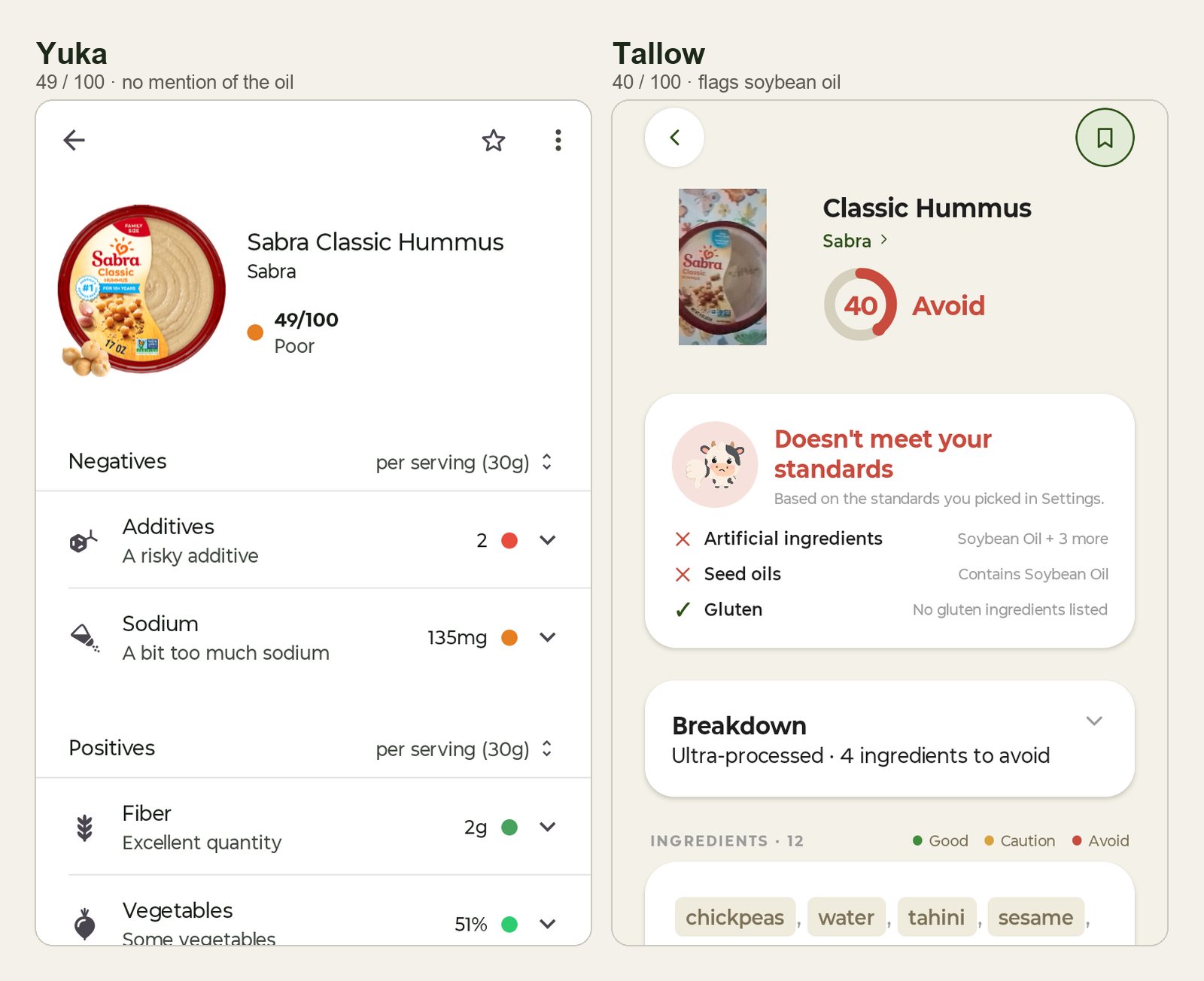
Yuka and Tallow landed close on the hummus on October 1 (Tallow's score has since dropped to 0, after Tallow started rating refined seed oils 0). Only one tells you it contains soybean oil. (Sabra Classic Hummus on Tallow.)
Yuka's food score is 60% Nutri-Score, and Nutri-Score treats a gram of canola oil and a gram of olive oil the same way. In fact it rewards "low saturated fat," which favors seed oils over butter. That's why Yuka gives Kerrygold butter a 30 ("all butters have bad ratings on Yuka"), lets a Nature Valley granola bar whose third ingredient is canola oil land in the same range, and never mentions the oil in either. (Our full Yuka review.)
Bobby Approved: the best free option
If you just want a free yes/no in the aisle, Bobby Approved is hard to beat. Seed oils are on Bobby Parrish's list of disqualifying ingredients, so anything made with them comes back Not Approved. It's free, it's fast, and it has more App Store ratings than any other app in this category.
The tradeoff is that it's all-or-nothing. A product with a little sunflower lecithin and a product fried in soybean oil get the same red "no," and two "Approved" products can be very different from each other. There's also no lab data, so it can't catch an "avocado oil" product that's been cut with something cheaper.
Tallow: seed oils as a dealbreaker, plus everything else
Tallow handles seed oils two ways:
- As a personal standard. Turn on "Seed oils" and any product with an ingredient list gets a clear Meets / Doesn't meet your standards verdict, naming the oil ("Contains Soybean Oil," "Contains Canola Oil"). It catches the label names that hide them, like "vegetable oil," and it's one-strike: a product that fails your seed-oil standard is a no, whatever its score.
- In the score. Every ingredient is rated individually, so a seed oil costs points, but it isn't the only thing that does. Ultra-processing, additives, packaging and lab-measured contaminants count too.
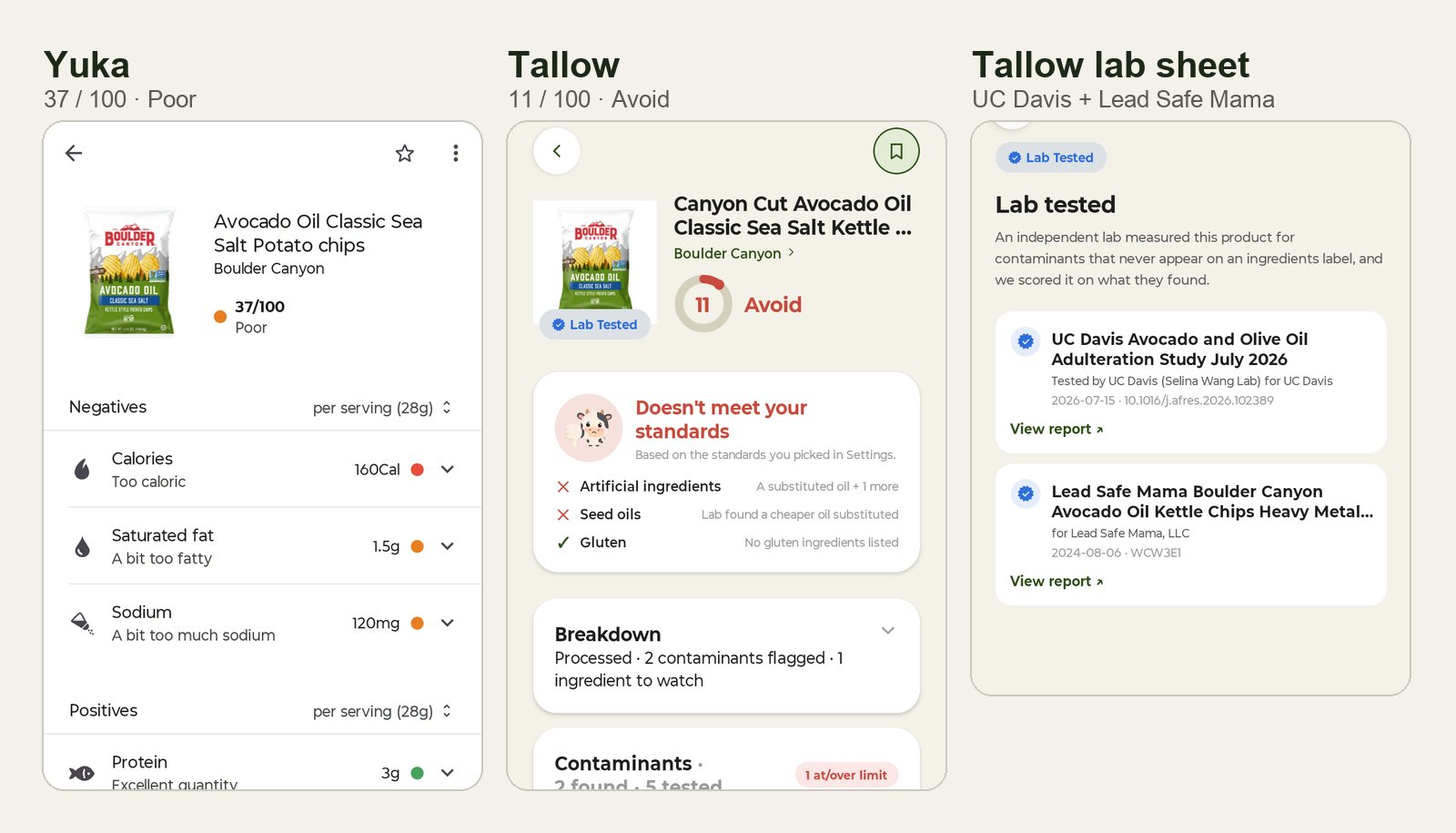
And because Tallow attaches lab results, it can catch the case no label-reader can: a July 2026 UC Davis study flagged Boulder Canyon's Canyon Cut avocado oil chips for oil substitution, and Tallow's product page says so ("Lab found a cheaper oil substituted"), with a link to the study.
At restaurants
Restaurant food is where most people's seed-oil intake actually comes from, and it's the one place a barcode scanner is useless. Fryer oil isn't on the receipt.
Seed Oil Scout: the restaurant specialist
Seed Oil Scout is the app most dedicated to this one problem. Its map shows which restaurants cook in what, with tags like grass-fed and gluten-free, and the company says it covers around 45,000 restaurants. Most of the data comes from its community. If eating out is your main concern and you're happy to pay for one more subscription, it's the most focused option.
Tallow's restaurant map
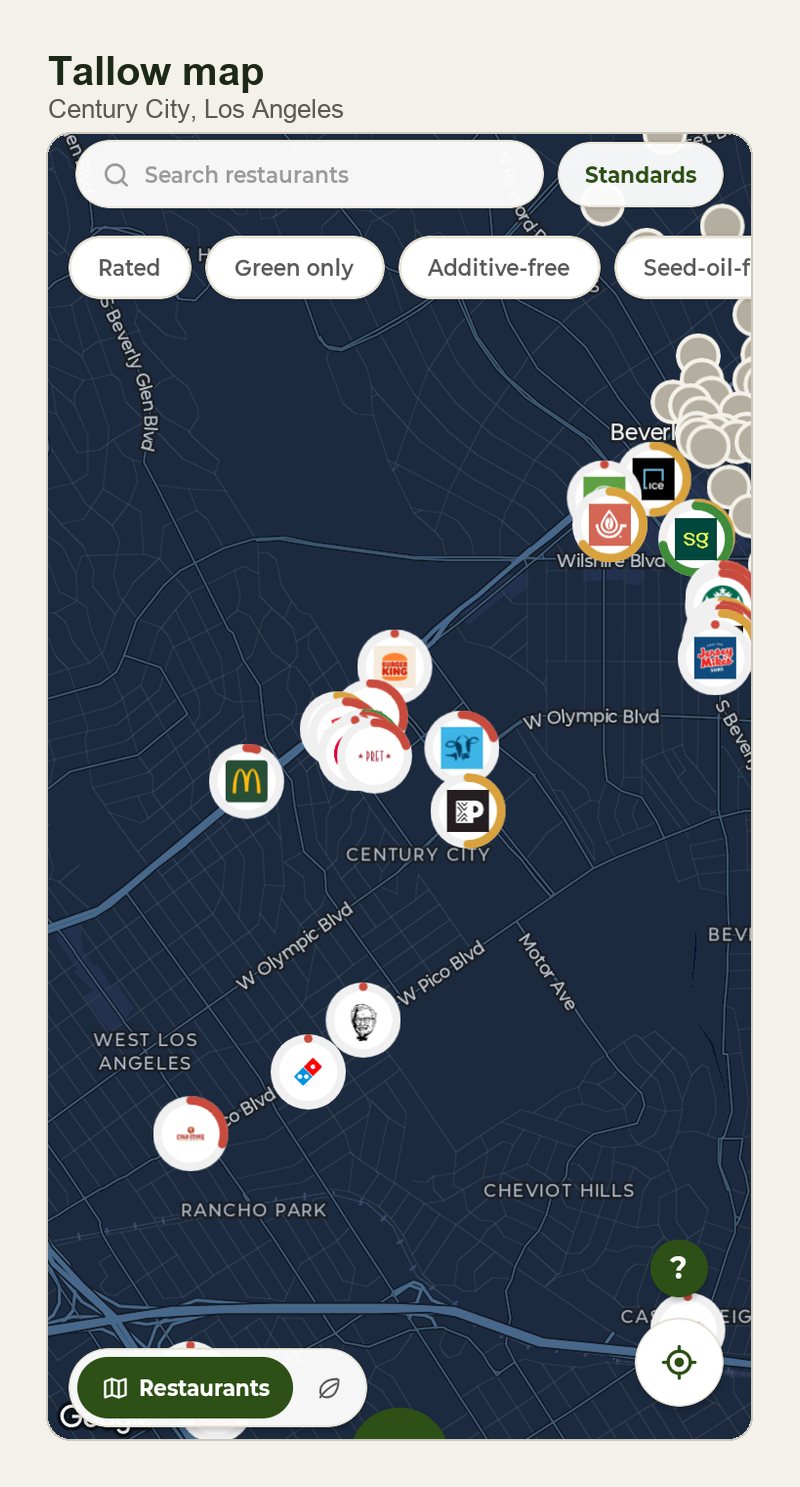
Tallow's map around Century City, Los Angeles. Colored rings are scored chains; grey dots are unrated.
Tallow's map shows every restaurant around you and scores chains on seed oils, additives, plastics and processing, mostly from Tallow's own research plus ratings from users, each weighted by the quality of its evidence. There are filters for Seed-oil-free, Additive-free and Green only. As of October 2026 it covers 234 chains, about 235,000 locations, and you can rate any unrated spot yourself. It's in the same app as the grocery scanner, so your standards apply in both places.
It's newer than Seed Oil Scout's map and has fewer independent restaurants rated. Where it's ahead is that you don't need a second app to go from the grocery store to dinner.
Which seed oil app should you get?
- Free, groceries only, simple yes/no: Bobby Approved.
- Eating out is the main problem: Seed Oil Scout.
- Free seed-oil checks for groceries and restaurants in one app, plus lab results that count toward the score: Tallow.
- Yuka or Oasis: great at other things, but they won't flag seed oils.
The easy way to start
You don't have to memorize the eight names of seed oils or read every label in the store. Open Tallow, turn on the seed-oil standard, and scan the five things you buy every week: the bread, the mayo, the hummus, the granola bars, the "avocado oil" chips. Anything with soybean, canola, sunflower or "vegetable oil" will say so in plain English, for free. With Premium, Tallow also shows you higher-scoring swaps from the same aisle. Then check the map before you pick where to eat tonight.
Method: Yuka and Tallow screenshots taken on a Moto G 5G (2024) on October 1, 2026. Other apps are described from their App Store and Google Play listings and company websites as of the same date; Seed Oil Scout's restaurant count is the company's own figure. Tallow restaurant coverage is from Tallow's database on October 1, 2026. Avocado oil finding: UC Davis (Selina Wang lab), July 2026. Updated November 15, 2026: Scout's seed-oil and lab details were checked against its methodology page and its price offer in its Android app, and Exposr's against its own App Store screenshots and fine print.