
Is the Yuka app accurate? We scanned 11 groceries to find out
Yuka gave a dandelion tea 100/100. A lab found 301 ppb of lead in it. We scanned 11 groceries in Yuka to see what its score can and can't tell you.

Maddox Schmidlkofer
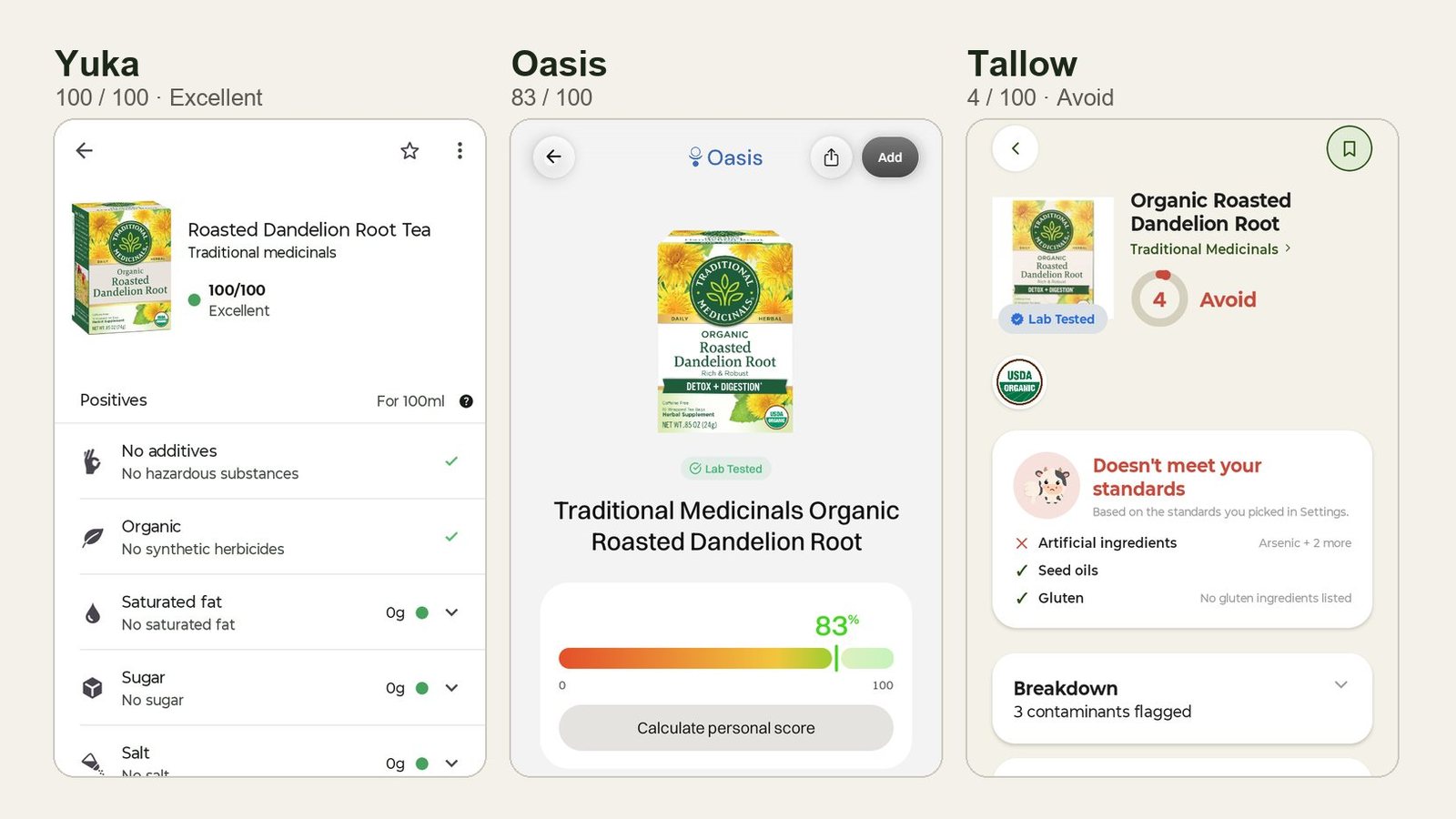
Yuka gave a box of Traditional Medicinals Organic Roasted Dandelion Root tea a perfect 100 out of 100. "Excellent." No additives, organic, zero sugar, zero salt.
In March 2026, an independent lab tested that same tea for heavy metals. It found 301 ppb of lead, 191 ppb of cadmium and 95.9 ppb of arsenic in the dry tea.
Both of those things are true at the same time, and the gap between them explains what the Yuka score actually measures. If you've been searching "is Yuka accurate" or "is the Yuka app legit," this is the answer, with screenshots.
Disclosure up front: I build Tallow, a food scanner that competes with Yuka. That's exactly why I did this the boring way. On October 1, 2026, I scanned the same 11 grocery products, by barcode, on the same Android phone, in Yuka, Oasis and Tallow, and I'm showing you every score, including the ones where Yuka looks good and the ones where Tallow is the odd one out.
What Yuka is
Yuka is a free barcode scanner from a small French company, launched in 2017. You scan a food or cosmetic, and it returns a score out of 100 with a colored dot: Excellent, Good, Poor or Bad. It's one of the most downloaded health apps in the world, and the company is proud that it takes no money from brands: no ads, no paid placements, no sponsored recommendations. That independence is real, and it's the best thing about Yuka.
How the Yuka score is calculated
For food, Yuka publishes its formula. The score is:
- 60% nutritional quality, using the Nutri-Score system (calories, sugar, saturated fat, salt, fiber, protein, fruit and vegetables)
- 30% additives, based on Yuka's risk rating of each E-number additive
- 10% organic, a bonus if the product is certified organic
Everything in that formula comes from the printed label: the nutrition facts panel and the ingredients list. That is the whole story of where Yuka is strong and where it's blind.
The 11-product test
Same barcodes, same day, same phone. Tallow and Oasis are included because people who compare Yuka usually compare it to one of them.
| Product | Yuka | Oasis | Tallow |
|---|---|---|---|
| Traditional Medicinals Roasted Dandelion Root tea | 100 Excellent | 83 | 4 Avoid |
| Driscoll's strawberries | 90 Excellent | 94 | 13 Avoid |
| Boulder Canyon Avocado Oil kettle chips | 37 Poor | not found* | 11 Avoid |
| Truvani Plant Based Protein, Chocolate | Not rated | not found* | 0 Avoid |
| Kerrygold Pure Irish Butter | 30 Poor | 80** | 100 Clean |
| California Olive Ranch extra virgin olive oil | 75 Excellent | 80 | 100 Clean |
| Sabra Classic Hummus | 49 Poor | 71 | 40 Avoid |
| Nature Valley Crunchy Oats 'n Honey bar | 42 Poor | 80 | 54 Okay |
| LMNT Watermelon Salt | 53 Good | 93 | 69 Okay |
| Coca-Cola, 12 oz can | 0 Bad | 50 | 0 Avoid |
*Oasis search didn't return this exact product (it listed sibling flavors and sizes instead). **Oasis only lists the unsalted Kerrygold; the other two apps scored salted.
The three apps agree on almost nothing, and the disagreements fall into clean patterns.
Where Yuka gets it right
Start with the fair part. Yuka and Tallow both gave Coca-Cola a 0. Both rated the Sabra hummus and the Nature Valley bar in the 40s and 50s. For the job Yuka was designed to do, telling you quickly that a product is sugary, salty or full of additives, it's fast, free and consistent, and its "Recs" tab is a genuinely useful way to find a better option on the same shelf.
It also covers cosmetics, which many food scanners don't, and it publishes exactly how its score is calculated.
If what you want is "eat less sugar and fewer additives," Yuka is accurate for that.
Where the Yuka score breaks down
1. It can't see anything that isn't printed on the package
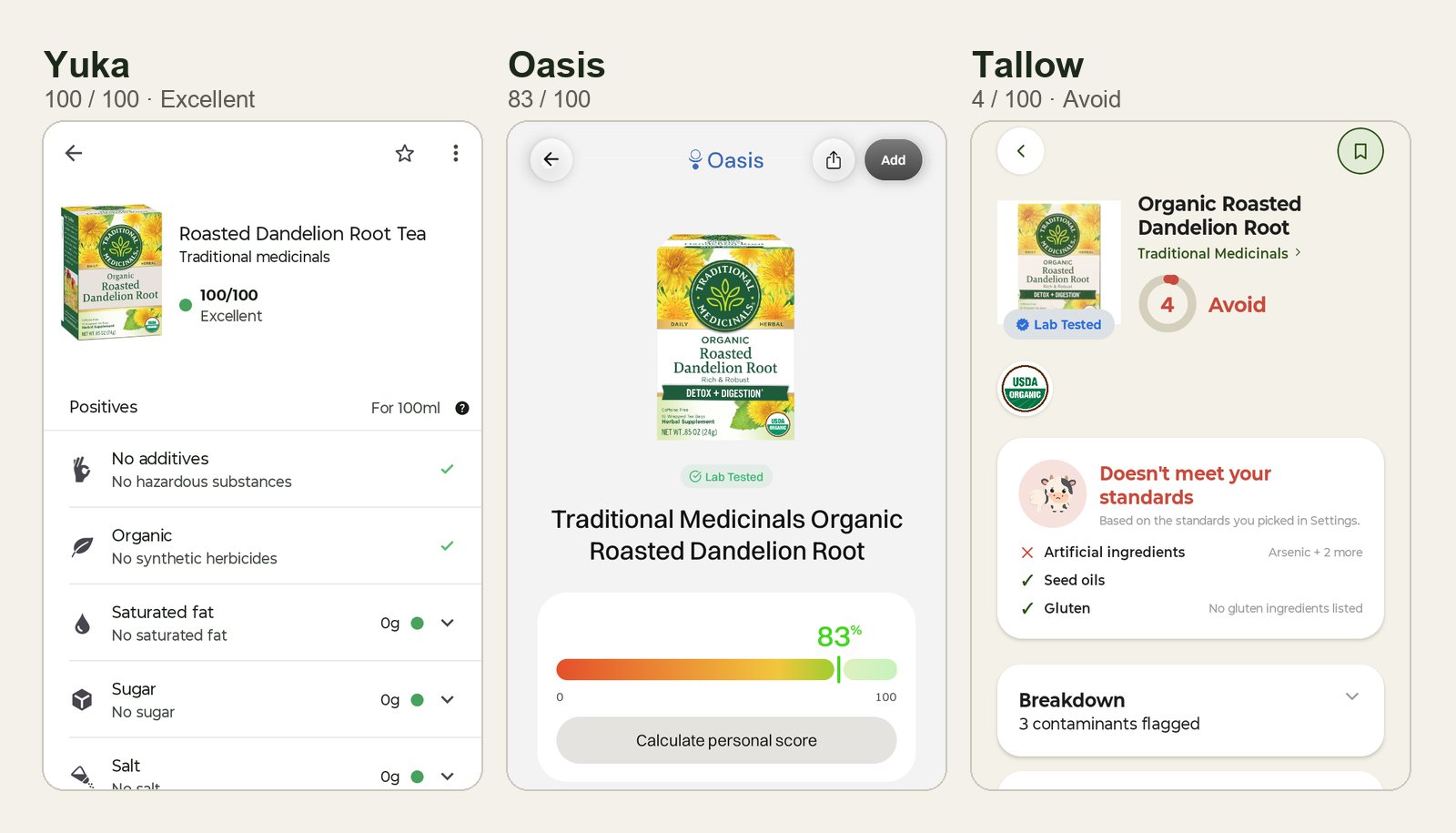
Same tea, same day. Yuka 100, Oasis 83, Tallow 4.
Heavy metals, pesticide residues, plastic chemicals and oil fraud never appear on an ingredients list, so they never enter the Yuka score. The dandelion tea scores 100 because its label is perfect: one organic ingredient, nothing added.
The lab numbers come from Lead Safe Mama, which sent the tea to Purity Laboratories in March 2026. To keep this honest, those numbers are measured in the dry tea leaves, and a single 1.5 g tea bag carries roughly 0.45 micrograms of lead, not all of which ends up in your cup. Oasis, which also has this report, judges it per serving and passes it. Tallow judges the concentration and fails it. You can disagree with either call. The point is that Yuka can't make the call at all, because it doesn't know the test exists. (You can see every number, and the limit it's compared against, on the tea's page on Tallow.)
The same thing happens with Driscoll's strawberries. Yuka gives them a 90: they're fruit, after all. A May 2026 Mamavation test of Driscoll's strawberries detected residues from roughly a dozen pesticides and their breakdown products. Detected isn't the same as over a legal tolerance, and Oasis's own test of the berries found far fewer. But "100% fruit, no sugar added" tells you nothing either way, and that's all Yuka can read.
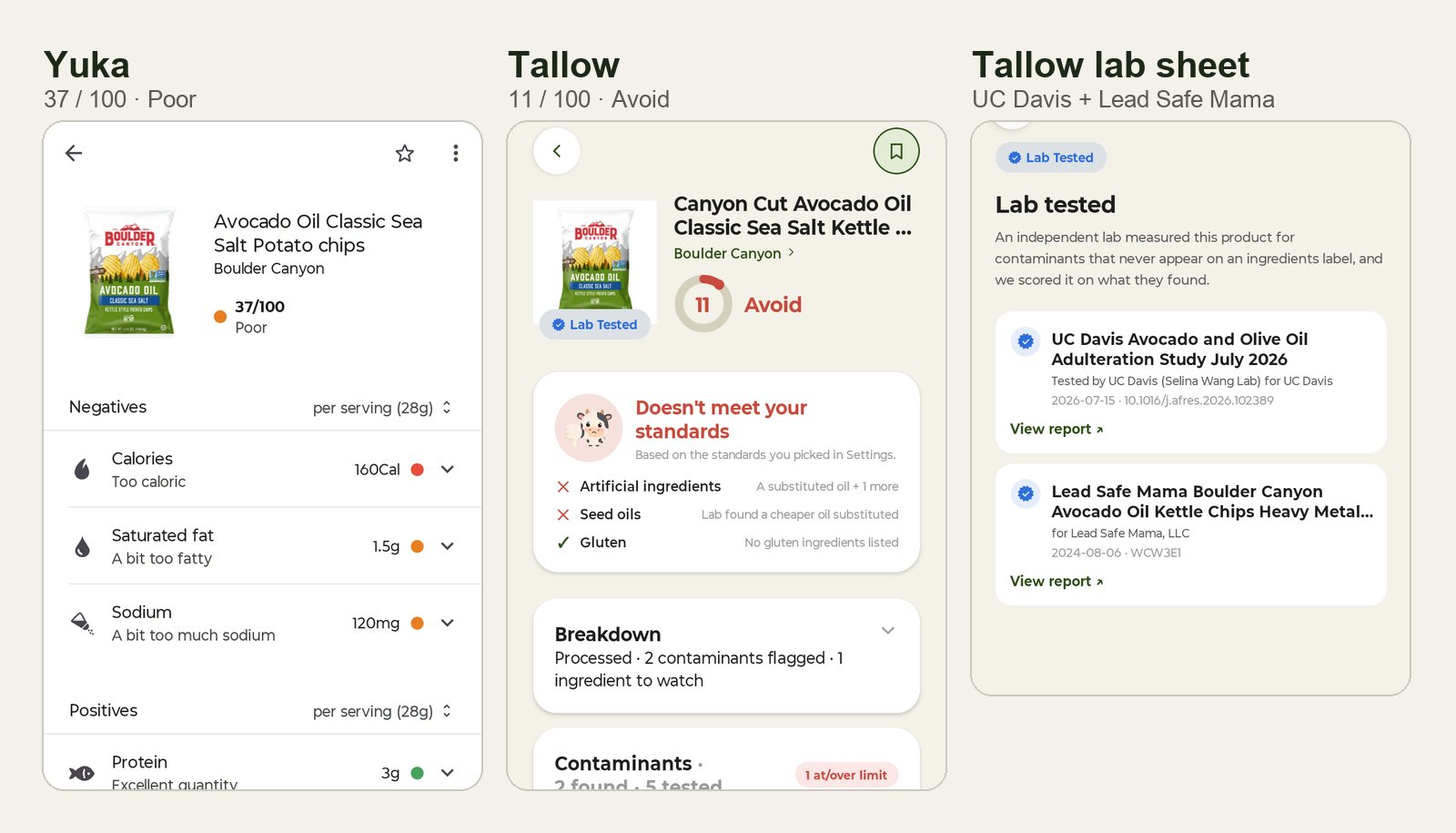
Yuka marks the chips down for calories. It has no way to know about the oil.
The clearest case is the avocado oil chips. Yuka gives them a 37, for calories and saturated fat. What it can't show is that a July 2026 UC Davis study of avocado oil products flagged this one as made with a cheaper substituted oil. If you buy avocado oil chips specifically to avoid seed oils, that's the only fact that matters, and it isn't on the bag. (We wrote about that study here.)
2. It judges fat by the gram, not by where it came from
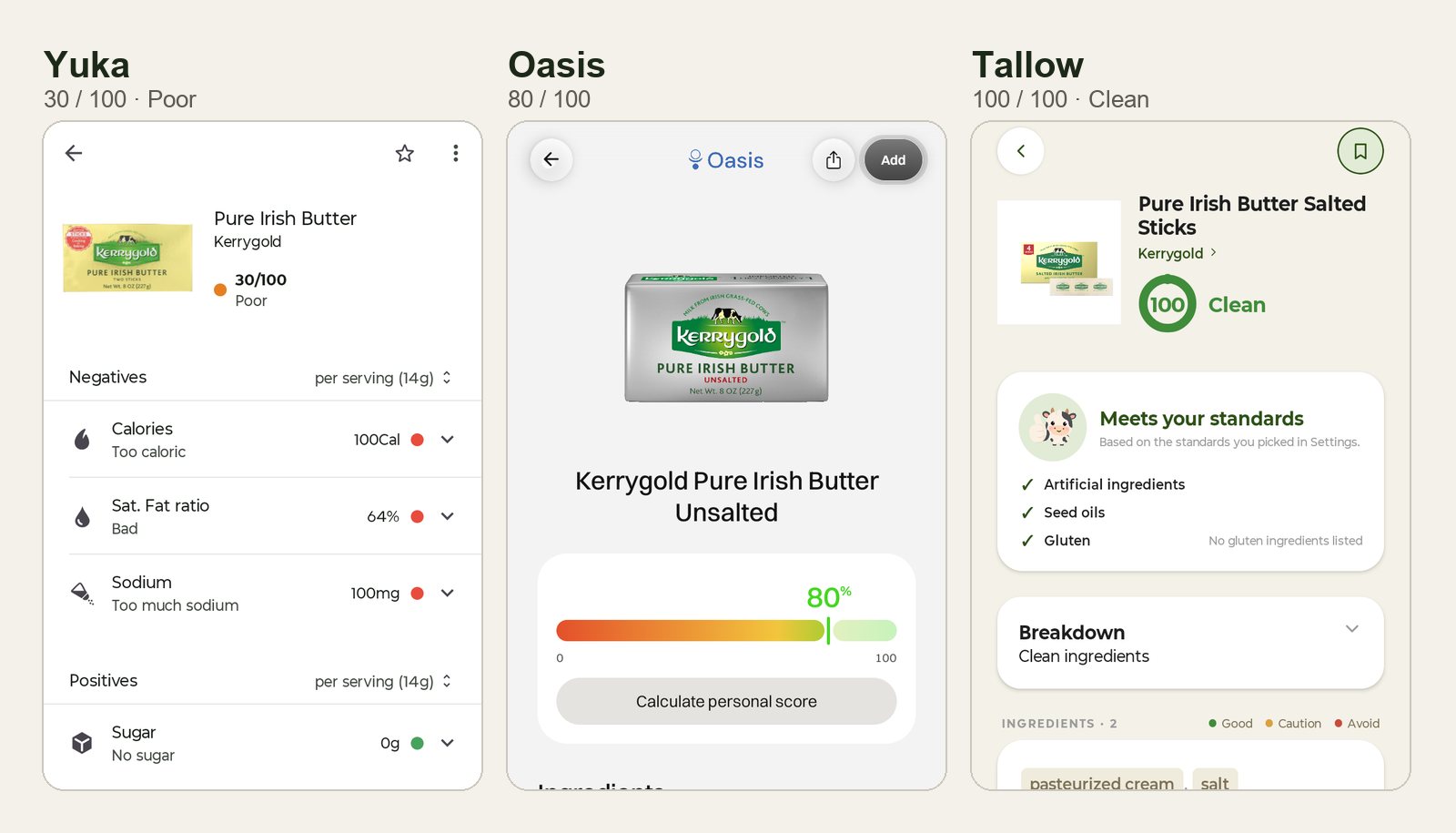
Yuka's own note: "All butters have bad ratings on Yuka because of their high saturated fat content."
Kerrygold, grass-fed Irish butter with two ingredients, scores 30, "Poor." (Kerrygold on Tallow scores it 100.) Yuka is upfront about why: the app tells you that all butters get bad ratings on Yuka, because Nutri-Score penalizes saturated fat and calories by quantity.
Olive oil gets a better result (75, "Excellent"), but even there Yuka puts a red "Too caloric" flag on it, because oil is fat and fat is calorie-dense.
That's a defensible position if you follow dietary guidelines that limit saturated fat. It's the opposite of what a lot of people who download food scanners in 2026 believe, and if you're in that group, Yuka will steer you away from food you consider clean.
3. It doesn't look at which oil is in the product
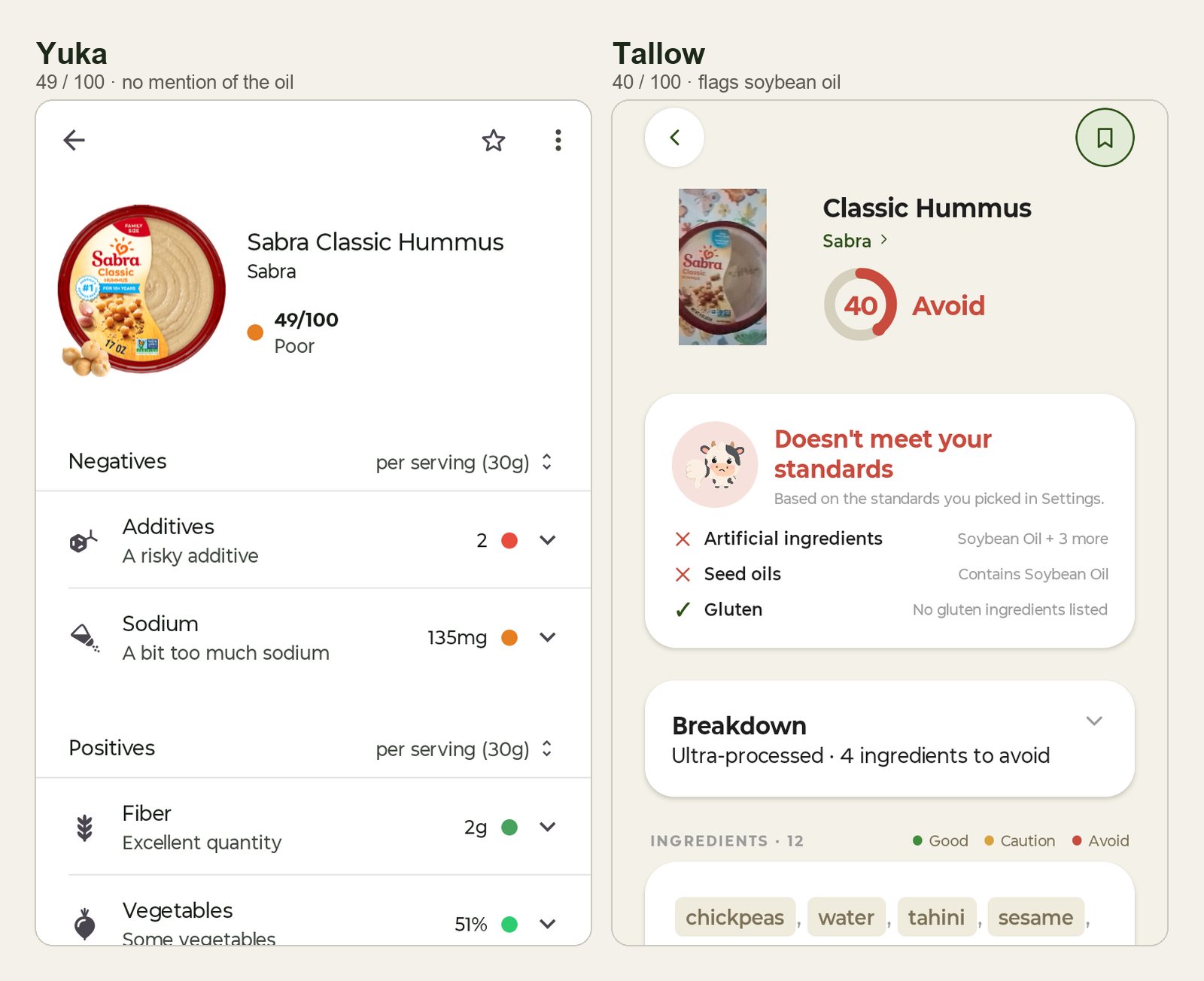
Similar score, different reasons. Tallow names the soybean oil; Yuka never mentions it.
Sabra's Classic Hummus and the Nature Valley granola bar land in the same range in Yuka and Tallow. Look at why, though. Yuka docks the hummus for "a risky additive" and sodium. The soybean oil in the hummus and the canola oil in the granola bar aren't mentioned anywhere on Yuka's screens, because Nutri-Score doesn't distinguish between oils; it only counts total and saturated fat. If seed oils are something you avoid, Yuka can't help you avoid them.
4. Some products just aren't rated
Truvani's chocolate plant protein came back with "Yuka doesn't know how to rate meal replacement drinks." Protein powders, supplements and some drink mixes fall outside the Nutri-Score system, and those categories are where heavy-metal testing finds the most problems. Truvani's chocolate protein is one of them: Lead Safe Mama's December 2024 test reported 128 ppb of cadmium. (More on cadmium in protein powder.)
Is Yuka free?
Scanning is free. Yuka Premium is "pay what you want," roughly $10 to $20 a year in the US, and unlocks search, offline mode and personal alerts for things like gluten or palm oil.
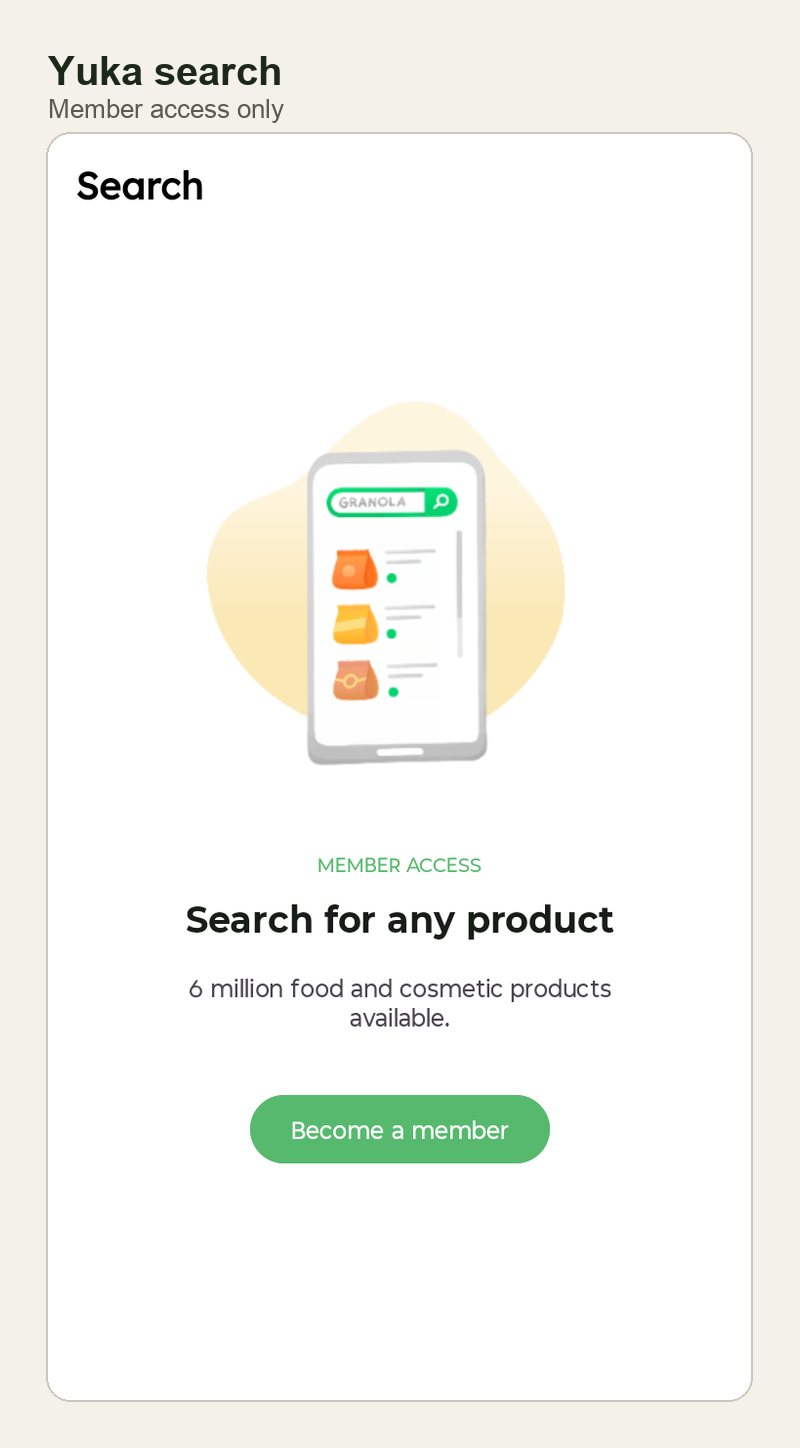
Search is members-only. On the free tier you can only scan a barcode you're holding.
The one free-tier limit that surprises people: search is members-only. You can't look up a product before you go to the store, and Yuka has no "type in a barcode" option, so if the camera won't read a crinkled label, you're stuck.
Is Yuka legit and safe to use?
Yes. It's a real company with a long track record. It doesn't sell your data to brands, and it famously went to court with the French cured-meat industry over its warnings about nitrites in ham and won on appeal. Nothing in this review suggests Yuka is dishonest. It does exactly what it says. The question is whether what it says is what you're actually worried about.
So, is Yuka accurate?
Yuka is an accurate nutrition label reader. If your goal is less sugar, less salt, fewer additives and less saturated fat, its score is consistent and its method is published.
It is not a contamination checker, a seed-oil checker or a "real food" checker, and it's not trying to be. A product can score 100 in Yuka and still have a lab report you'd want to read before you buy it.
If you want what Yuka can't see
That gap is the reason Tallow exists. Tallow reads the label too: it scores ingredients, additives, ultra-processing (NOVA) and packaging. But when an independent lab has tested a product, the results go into the score, and the product gets a Lab Tested badge. Tap it and you see who ran the test, who paid for it, the date, and a link to the original report. You don't have to take our word for anything; you can read the same report we did.
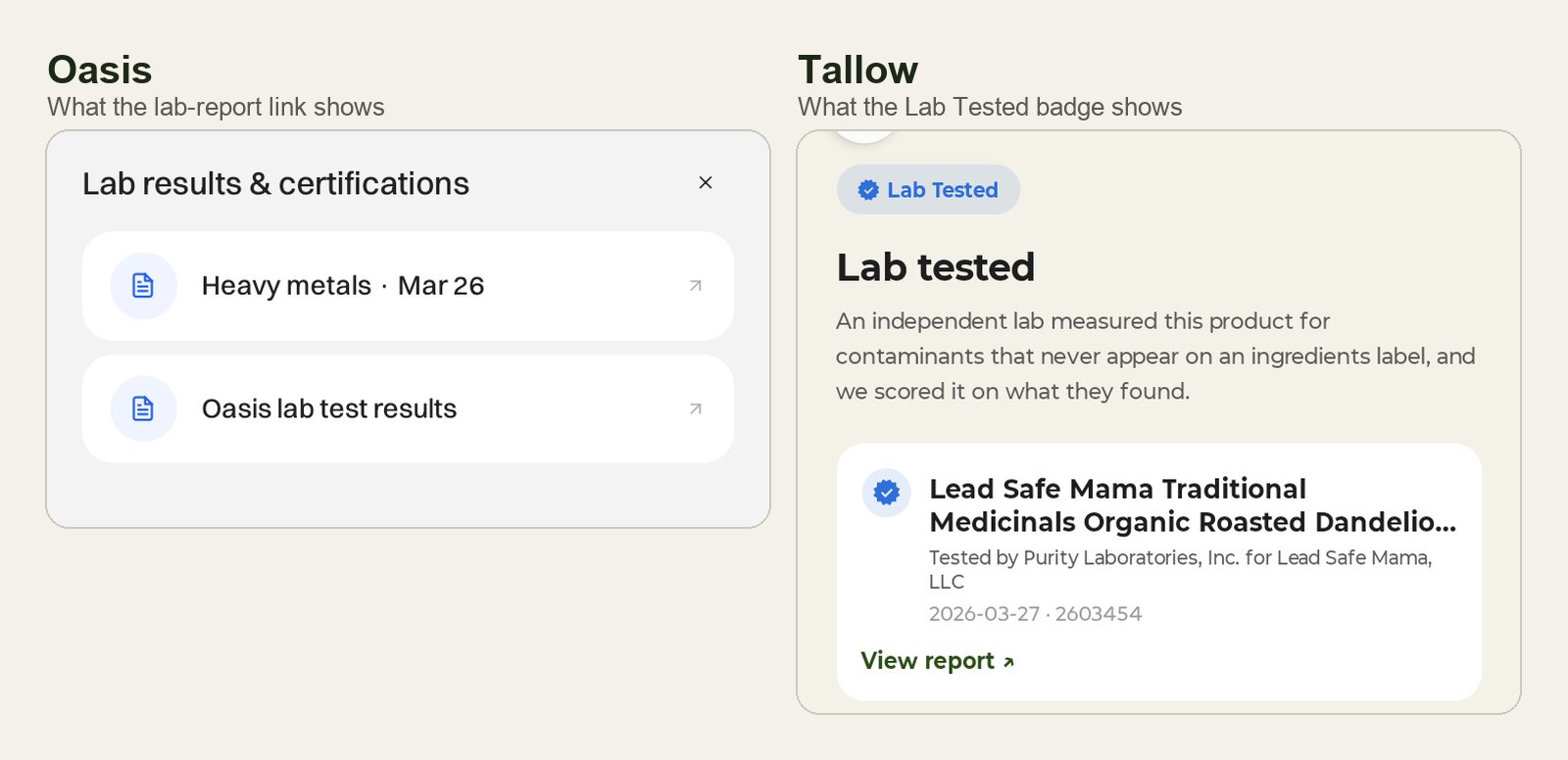
It also does the two things Yuka deliberately doesn't:
- Seed oils: turn on the seed-oil standard and every product containing canola, soybean, corn, sunflower or "vegetable oil" gets a clear no, whatever its score.
- Fat by source, not by gram: grass-fed butter and real olive oil score as the whole foods they are.
Scan the products in your pantry that Yuka rated Excellent. If one of them has a lab report, Tallow will show it to you, and you can decide for yourself.
Method: all 11 products were scanned by UPC barcode on a Moto G 5G (2024) on October 1, 2026, using the current Play Store versions of Yuka, Oasis and Tallow, on free accounts except Tallow. Scores change as apps update their databases. Lab figures are from the reports linked in each Tallow product page: Lead Safe Mama/Purity Laboratories (dandelion tea, March 2026), Lead Safe Mama/SGS (Truvani, December 2024), Mamavation (Driscoll's, May 2026), Oasis (Driscoll's, May 2026) and UC Davis (avocado oil, July 2026). Yuka's scoring method is from Yuka's help center.