
Amazon sold ground beef for $1.99 a pound. Here's what the listing won't tell you about where it came from
Amazon Grocery's 80/20 sold at $1.99 while the national average hit a record $6.89. We read the listing, the Whole Foods antibiotics case, and what the label is actually required to say.

Emily Harper
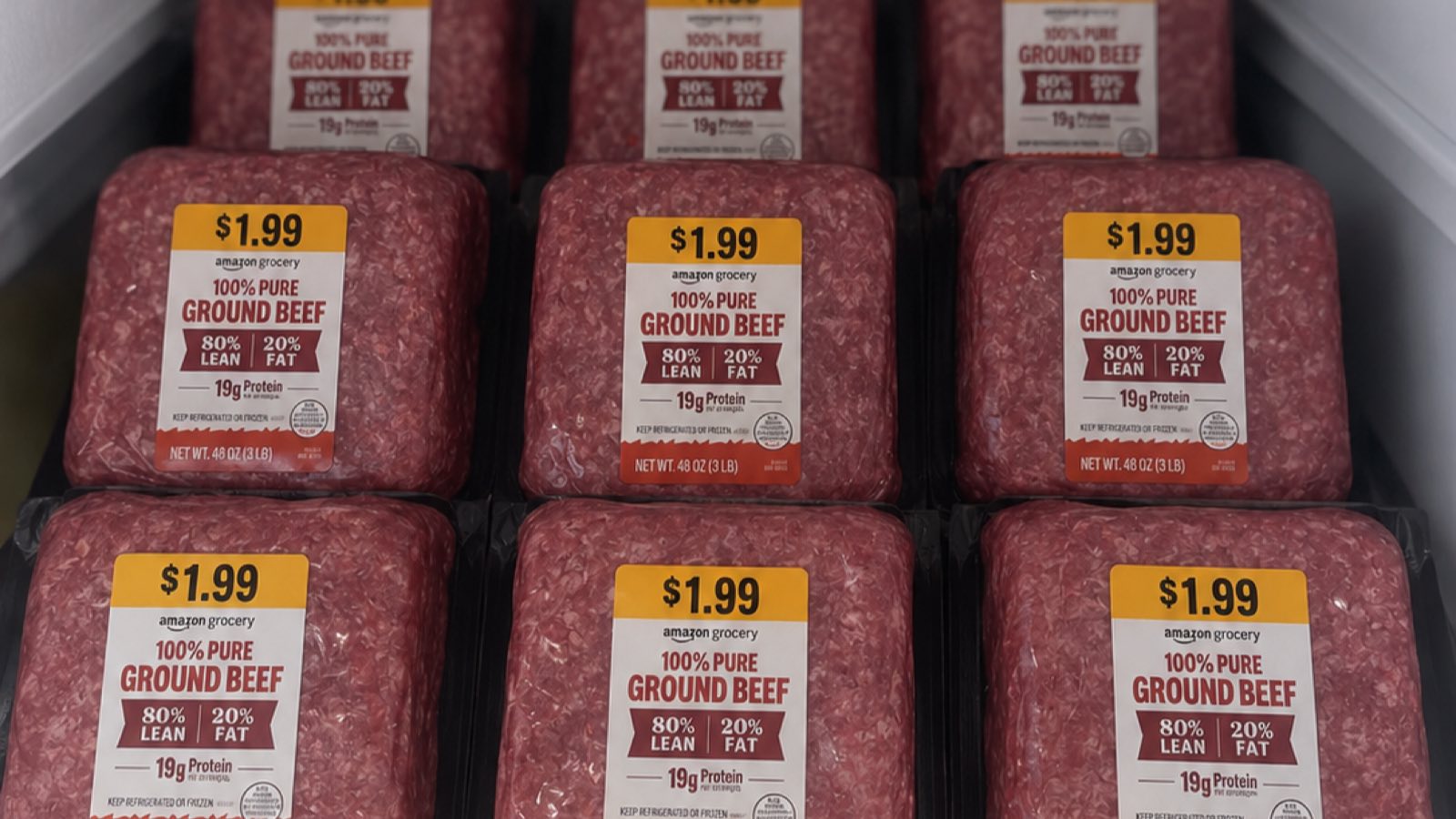
For most of late August, Amazon Grocery's 80% lean ground beef was $1.99 a pound. The same one-pound package lists at $6.99. The July national average for fresh 100% ground beef was $6.885 a pound, a record, so $1.99 came in roughly 71% below what the rest of the country was paying.
That is a big enough gap that the internet skipped straight to the obvious question. Not "should I buy this," but "what is in it, and where did it come from." The top rising Google searches attached to it right now are 1.99 ground beef amazon, where is the imported beef coming from, and uninspected imported beef recall, the last one up more than 4,500%.
Here is what's actually documented, what's being assumed, and what the package does and doesn't have to tell you.
What Amazon actually sold
The item is Amazon Grocery, Ground Beef, 80% Lean/20% Fat, 1 lb (ASIN B08LJVQSL2, UPC 195515005838). It is the #1 best seller in Amazon's Ground Beef category, with more than 100,000 bought in the past month and 26,000-plus ratings.
The $1.99 price ran for Prime members in select delivery markets, capped at five packages per customer, and was scheduled to end August 30. It sold out unevenly — some shoppers reported it gone by August 28 while it was still orderable in South Florida and Ohio. And it wasn't the first run: third-party sales estimates put roughly 70,000 one-pound packages sold at $1.99 in July, which made it the top-selling listing in its category that month.
As of this writing the price is back to $6.99.
The timeline doesn't support the story people are telling
The assumption spreading fastest is that $1.99 beef is the tariff-free import beef arriving cheap. The dates don't work.
On August 21, 2026, Trump signed a proclamation suspending the out-of-quota tariff on up to 300,000 metric tons — about 660 million pounds — of beef for 90 days, specifically lean beef trimmings, the input blended with fattier domestic beef to make ground beef. Entry under that window opened September 1. The proclamation states an expectation that the beef retails around 25% below market.
Amazon's $1.99 promotion ran in July and ended August 30. Both were over before a single pound could enter under the new window. Whatever explains the price, it isn't that.
What it looks like instead is a loss leader — the oldest move in grocery, where one tracked staple gets priced below cost because shoppers remember milk, eggs and ground beef and don't audit the other thirty items in the cart. That is a marketing decision, not a quality disclosure. It tells you nothing about the meat in either direction.
Worth noting separately: on September 2 the Justice Department expanded its beef antitrust inquiry beyond the Big Four meatpackers, sending demands for retail pricing data to eight grocers including Amazon, Walmart, Costco, Kroger, Albertsons, Ahold Delhaize's US unit, Publix and Aldi. No allegations have been made against any of them. It's a document request.
What the listing tells you about origin
We read the entire product page. Here's the complete set of sourcing information on it:
| Field on the listing | What it says |
|---|---|
| Ingredients | "Ground Beef" |
| Manufacturer | Amazon.com Services LLC |
| Product description | "100% pure ground beef" |
| Country of origin | not listed |
| Farm, ranch or feedlot | not listed |
| Processing establishment | not listed |
| "Product of USA" claim | not present |
That is not a violation. Congress repealed mandatory country-of-origin labeling for beef in December 2015, and nothing has replaced it. USDA's "Product of USA" rule became enforceable on January 1, 2026, and it did make that claim mean something real — born, raised, slaughtered and processed here, with records FSIS can audit — but the claim is voluntary. We went through the mechanics of that rule, and the 29,628-pound Argentine beef recall that skipped import re-inspection entirely, in a separate piece.
So read the absence correctly. No origin claim is not evidence the beef is imported. It's evidence that nobody is required to tell you, and that Amazon has chosen not to. Those are different things, and only one of them is Amazon's decision.
"But Amazon owns Whole Foods"
It does. That doesn't transfer to this package, and the distinction is the whole ballgame.
Amazon Grocery is not Whole Foods. It launched October 1, 2025 as a consolidation of the old Amazon Fresh and Happy Belly house brands, sold on Amazon.com and in Amazon Fresh stores. Whole Foods has its own separate private label, 365 by Whole Foods Market. Whole Foods' meat standards govern the meat department at Whole Foods.
Those standards are genuinely strict on paper. Whole Foods' published beef standards require "no antibiotics, ever," no added hormones, and that "animal products must be traceable back to the farm(s) or ranch(es)." In February 2026 the company adopted RaiseWell Certified for Beef, a third-party program audited by Where Food Comes From, Inc. that requires source verification back to the farm of origin plus no antibiotics or added growth hormones.
Two caveats that matter:
- Whole Foods' own standards page says all fresh beef must meet a third-party certified animal welfare standard — G.A.P., A Greener World, Certified Humane, Regenerative Organic Certified or RaiseWell — by the end of 2026. That's a deadline in progress, not a completed state.
- Traceability to a farm is not a country-of-origin claim printed on your package. Whole Foods' standards document does not specify country-of-origin requirements for beef. The chain knowing where an animal came from and you knowing are two different systems.
Either way: none of it applies to the $1.99 Amazon Grocery pack, which is a different brand sold through a different channel.
The antibiotics case, stated precisely
The federal class action is Safari et al. v. Whole Foods Market, Inc., No. 8:22-cv-01562, filed in the Central District of California in August 2022 by three consumers and the nonprofit Farm Forward. The complaint alleges that in 2021 and 2022, independent lab testing of meat bought at six Whole Foods locations found residues of monensin sodium, an antibiotic, and fenbendazole, an antiparasitic, in beef sold under the "No Antibiotics, Ever" claim.
On July 25, 2023, Judge John W. Holcomb let the case proceed for one consumer plaintiff on fraud, breach of warranty and unjust enrichment, and denied Whole Foods' bid to stay discovery. Whole Foods has argued the plaintiffs failed to allege a concrete injury. These are allegations. There has been no finding of liability, and the case remains pending.
The bigger number is the one nobody sued over. USDA's Food Safety and Inspection Service ran an exploratory sampling program on cattle sold into the "Raised Without Antibiotics" market: liver and kidney samples from 196 cattle at 84 slaughter establishments across 34 states, screened against more than 180 veterinary drugs. Residues turned up in about 20% of samples — macrolides confirmed in 11% of the animals, plus tetracyclines, monensin, sulfamethazine and penicillin G metabolites. In August 2024 USDA responded by updating its guideline to recommend that companies making "raised without antibiotics" claims either run routine pre-slaughter testing or obtain third-party certification that includes testing.
That's the real finding, and it isn't about one retailer. An unverified animal-raising claim on a package failed roughly one time in five when the government actually tested for it. The fix USDA landed on was third-party verification — which is exactly what a program like RaiseWell is, and exactly what a plain "100% pure ground beef" description isn't.
What actually works at the counter
- Don't read price as a quality signal, in either direction. $1.99 doesn't mean the beef is bad. $6.99 doesn't mean it's good. A loss leader is a line in a marketing budget.
- Treat "Product of USA" as a real claim and silence as no claim. Since January 1, 2026 that label means born, raised, slaughtered and processed here with auditable records. "Processed in the USA" means the last step happened here and nothing more.
- Be pickiest about ground beef specifically. Whole muscle cuts keep their identity. Ground beef is the category where imported lean trimmings get blended with domestic fat — it's the exact product the 300,000-tonne window targets.
- Prefer a third-party certification over a marketing phrase. G.A.P., A Greener World, Certified Humane, Regenerative Organic Certified, RaiseWell. USDA's own sampling is the argument for why an audited claim beats a self-declared one.
- If origin matters to you, ask. A butcher counter or a farm you can name answers the question directly instead of depending on what a label rule happens to require this year.
Let us do the other half
Origin is one question about a package of meat. What's actually in it is the other one, and that takes about two seconds.
Point Tallow at the barcode. We read the ingredient panel, score the product out of 100, and say in plain English what every additive is doing and why it moved the number. Real ground beef is one ingredient, so a clean package scores 100. It's the processed stuff on the next shelf over — the smoked sausages, the pre-formed patties, the "uncured" franks — that collapses into single digits once you read the panel instead of the front.
Sourcing counts too. Grass-fed, pasture-raised, organic and US-raised claims come through attached to the product rather than getting stripped off as marketing, because they change the score. Open Meat & Seafood and fresh meat comes back ranked, so you can see the clean options first instead of standing in an aisle comparing two fronts of packaging that both say "premium."
Download Tallow and scan whatever's in your cart right now.
Prices, dates, case details and test results in this post come from the government notices, court filings, agency pages, company statements and press coverage linked above, current as of publication. The Whole Foods litigation is pending and the allegations in it are unproven. No claim is made here that Amazon's $1.99 ground beef was imported, domestic, or of any particular quality — that information is not disclosed on the listing.