TallowTallow
Colgate Colgate Cavity Protection Fluoride Toothpaste plastic tube

Colgate Cavity Protection Fluoride Toothpaste plastic tube

—Unrated

Contaminants · 18

3 at/over limit

Measured by an independent lab and compared against published safety limits.

Di(2-ethylhexyl) Phthalate (DEHP)44.5 ppbof 6 ppb
Over the limit — 7.4×US EPA drinking-water MCL, 40 CFR 141.61(c) — 0.006 mg/L. Applied to all foods as the TIGHTEST published DEHP number; the EU food-contact limit is looser (Reg. (EU) 10/2011 as amended by 2023/1442: SML 0.6 mg/kg, plus the 0.6 mg/kg DEHP-equivalent group limit with DBP/BBP/DIBP).
Diethylphthalate29 ppbof 10 ppb
Over the limit — 2.9×DEP is not on the EU Union list of substances authorised in food-contact plastics (Reg. (EU) 10/2011 Annex I), so no migration is permitted. Set at 0.01 mg/kg, the detection limit 10/2011 uses for not-detectable (ND) restrictions.
Dimethylphthalate10.1 ppbof 10 ppb
Just over the limitDMP is not on the EU Union list of substances authorised in food-contact plastics (Reg. (EU) 10/2011 Annex I), so no migration is permitted. Set at 0.01 mg/kg, the detection limit 10/2011 uses for not-detectable (ND) restrictions.
Dibutyl Phthalate40.8 ppbof 120 ppb
34% of the limitEU food-contact plastics, Reg. (EU) 10/2011 as amended by 2023/1442 — DBP SML 0.12 mg/kg (cut from 0.3). Also inside the 0.6 mg/kg DEHP-equivalent group limit (DBP x5).
Diisobutyl Phthalate14.7 ppbof 150 ppb
10% of the limitEU food-contact plastics, Reg. (EU) 2023/1442 group restriction — DBP x5 + DIBP x4 + BBP x0.1 + DEHP <= 0.6 mg/kg DEHP-equivalents, so DIBP alone may not exceed 0.15 mg/kg. DIBP is not itself an authorised substance.
Di (2-ethylhexyl) Terephthalate0.0359 ppmof 60 ppm
<1% of the limitEU food-contact plastics, Reg. (EU) 10/2011 — DEHT (FCM 798) SML 60 mg/kg, group restriction with DINCH. No tighter published limit exists (EFSA TDI 1 mg/kg bw/day).
Diethylhexyl Adipate0.0085 ppmof 18 ppm
<1% of the limitEU food-contact plastics, Reg. (EU) 10/2011 — DEHA (FCM 207) SML 18 mg/kg.
Benzylbutyl PhthalateNDof 6 ppm
Not detectedEU food-contact plastics, Reg. (EU) 10/2011 as amended by 2023/1442 — BBP SML 6 mg/kg (cut from 30). Also inside the 0.6 mg/kg DEHP-equivalent group limit (BBP x0.1 = 6 mg/kg alone).
Bisphenol a (BPA)NDof 1 ppb
Not detectedEU Reg. (EU) 2024/3190 — BPA banned in food-contact materials from 20 Jan 2025 (old 0.05 mg/kg SML repealed); the residual exemptions require NO detectable migration at a 1 ug/kg detection limit. 1 ppb is therefore the tightest published number.
BpfNDof 10 ppb
Not detectedNot on the EU Union list of substances authorised in food-contact plastics (Reg. (EU) 10/2011 Annex I), and Reg. 2024/3190 restricts hazardous bisphenols; no migration is permitted. Set at 0.01 mg/kg, the detection limit 10/2011 uses for not-detectable (ND) restrictions.
BPS (Bisphenol s)NDof 50 ppb
Not detectedEU food-contact plastics, Reg. (EU) 10/2011 — BPS (4,4'-sulphonyldiphenol) SML 0.05 mg/kg; BfR applies the same 0.05 mg/kg.
Di-n-octyl PhthalateNDof 10 ppb
Not detectedDNOP is not on the EU Union list of substances authorised in food-contact plastics (Reg. (EU) 10/2011 Annex I), so no migration is permitted. Set at 0.01 mg/kg, the detection limit 10/2011 uses for not-detectable (ND) restrictions.
Dicyclohexyl PhthalateNDof 10 ppb
Not detectedDCHP is not on the EU Union list of substances authorised in food-contact plastics (Reg. (EU) 10/2011 Annex I), so no migration is permitted. Set at 0.01 mg/kg, the detection limit 10/2011 uses for not-detectable (ND) restrictions.
Dihexyl PhthalateNDof 10 ppb
Not detectedDNHP (di-n-hexyl phthalate, EU Repr. 1B) is not on the EU Union list of substances authorised in food-contact plastics (Reg. (EU) 10/2011 Annex I), so no migration is permitted. Set at 0.01 mg/kg, the detection limit 10/2011 uses for not-detectable (ND) restrictions.
Diisodecyl AdipateNDof 10 ppb
Not detectedDIDA (diisodecyl adipate) is not on the EU Union list of substances authorised in food-contact plastics (Reg. (EU) 10/2011 Annex I), so no migration is permitted. Set at 0.01 mg/kg, the detection limit 10/2011 uses for not-detectable (ND) restrictions.
Diisodecyl PhthalateNDof 1.8 ppm
Not detectedEU food-contact plastics, Reg. (EU) 10/2011 as amended by 2023/1442 — DINP+DIDP group SML 1.8 mg/kg (sum). Applied to each alone.
Diisononyl 1,2-cyclohexanedicarboxylic AcidNDof 60 ppm
Not detectedEU food-contact plastics, Reg. (EU) 10/2011 — DINCH (FCM 775) group restriction with DEHT, 60 mg/kg. No tighter published limit exists (EFSA TDI 1 mg/kg bw/day).
Diisononyl ortho PhthalateNDof 1.8 ppm
Not detectedEU food-contact plastics, Reg. (EU) 10/2011 as amended by 2023/1442 — DINP+DIDP group SML 1.8 mg/kg (sum). Applied to each alone.

Ingredients · 9

GoodCautionAvoid

,,,,,,,,

Healthier swaps

Same shelf, cleaner ingredients

Browse Toothpaste

Common questions

What is in Colgate Cavity Protection Fluoride Toothpaste plastic tube?

Colgate Cavity Protection Fluoride Toothpaste plastic tube lists 9 ingredients, starting with Sodium Fluoride, Sorbitol, Hydrated Silica, Sodium Lauryl Sulfate and Polyethylene Glycol 600. Ingredients are listed in descending order by weight, so the first few make up most of what you are eating.

Does Colgate Cavity Protection Fluoride Toothpaste plastic tube contain seed oils?

No. Nothing in Colgate Cavity Protection Fluoride Toothpaste plastic tube’s ingredient list matches a seed oil — canola, soybean, corn, cottonseed, grapeseed, sunflower, safflower, rice bran or peanut oil, or an unspecified "vegetable oil".

How processed is Colgate Cavity Protection Fluoride Toothpaste plastic tube?

Colgate Cavity Protection Fluoride Toothpaste plastic tube has no NOVA group. Tallow works NOVA out from the ingredient list, and it does not apply to supplements or non-food products; a food whose ingredients are not all classified yet stays unknown instead of being guessed. Either way the processing axis scores it neutrally.

How does Colgate Cavity Protection Fluoride Toothpaste plastic tube compare to other toothpaste?

We haven't scored Colgate Cavity Protection Fluoride Toothpaste plastic tube yet, so there's nothing to compare it against in toothpaste.

Is Colgate Cavity Protection Fluoride Toothpaste plastic tube organic?

Colgate Cavity Protection Fluoride Toothpaste plastic tube is not certified organic in our data.

Has Colgate Cavity Protection Fluoride Toothpaste plastic tube been lab tested?

Yes. 18 substances in Colgate Cavity Protection Fluoride Toothpaste plastic tube have a laboratory result on file — see the Contaminants section above for each reading and the limit it was measured against.

Does Colgate Cavity Protection Fluoride Toothpaste plastic tube contain phthalates?

Yes. A lab detected DEHP at 44.5 ppb against a 6 ppb limit, dibutyl phthalate at 40.8 ppb against a 120 ppb limit, diethylphthalate at 29 ppb against a 10 ppb limit, diisobutyl phthalate at 14.7 ppb against a 150 ppb limit and 1 other in Colgate Cavity Protection Fluoride Toothpaste plastic tube. It tested for 6 other phthalates and found none above its detection limit. Each reading is in the Contaminants section above.

Full methodology: how we score products.
More in Toothpaste

10

Max Clean Gentle Mineral Scrub

Colgate

10

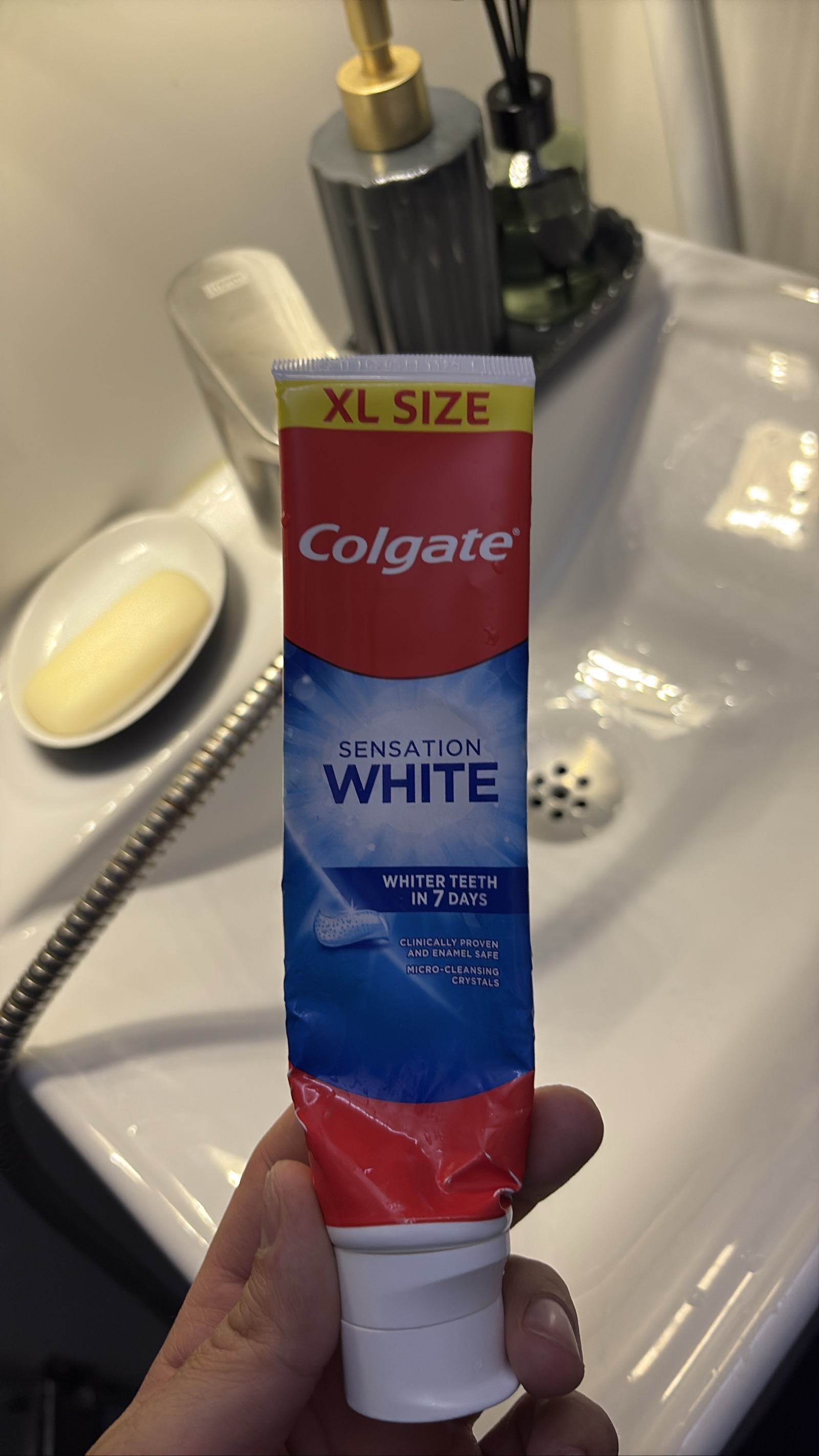
Sensation White Toothpaste

Colgate

76

Organic Toothpaste Peppermint

Essential Oxygen

76

Daily Care Peppermint Toothpaste

LOGONA

73

Kids CoComelon Fluoride-Free Natural Watermelon Flavor Training Toothpaste

Orajel

73

Naturals Ms. Rachel Training Toothpaste Natural Watermelon

Orajel