
The 'healthier' lunch kits tested worse for heavy metals than Lunchables
Lunchly and Greenfield Natural Meat Co. both market themselves as the better lunch kit. Consumer Reports' July 2025 lab results say one ties Lunchables' worst lead result, and the other posts the highest cadmium of anything in the test.

Maddox Schmidlkofer

I went looking for the "better" lunch kit. Lunchly — the meal kit MrBeast, Logan Paul and KSI launched in September 2024 as a self-described healthier Lunchables — is now next to the original on the shelf, and grocery-store "natural" brands like Greenfield Natural Meat Co. sit right beside both. Consumer Reports actually tested them. The lab numbers say the "better" ones are not better, and one of them is the single worst result in the whole panel.
What Consumer Reports actually tested
In July 2025, CR published heavy-metal results for 15 lunch/snack kits: the original Lunchables lineup, Armour LunchMakers, Good & Gather (Target's house brand), Oscar Mayer, P3, and — for the first time — three flavors of Lunchly, alongside Greenfield Natural Meat Co.'s kits. Every sample was tested for total arsenic, cadmium, and lead by an independent lab, reported both as a concentration (parts per billion, ppb) and as a dose per labeled serving (micrograms, mcg).
Here is CR's own results table:
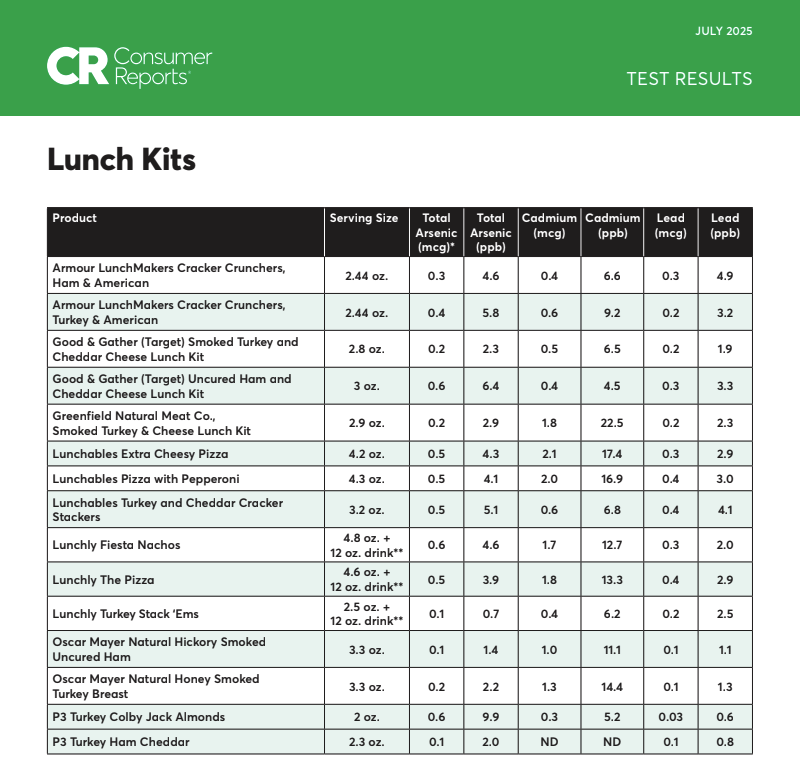
Source: Consumer Reports, "Test Results: Lunch Kits," July 2025. The Lunchly kits were tested in 2025; every other product was tested in 2024 as part of CR's original Lunchables investigation and re-published alongside the new numbers for comparison.
The two numbers that matter, lined up against the legal limit
California's Prop 65 sets a Maximum Allowable Dose Level — the daily oral exposure a company can sell you without triggering a required cancer/reproductive-harm warning label — of 0.5 micrograms a day for lead and 4.1 micrograms a day for cadmium. Nobody else in the country regulates heavy metals in a lunch kit at all, so this is the only number in existence to check these against. Below is CR's raw data with our own column added: percent of that daily allowance one kit alone uses up.
| Product | Serving | Cadmium (ppb) | Lead (mcg) | % of daily lead limit | % of daily cadmium limit |
|---|---|---|---|---|---|
| Greenfield Natural Meat Co., Smoked Turkey & Cheese | 2.9 oz | 22.5 | 0.2 | 40% | 44% |
| Lunchables Extra Cheesy Pizza | 4.2 oz | 17.4 | 0.3 | 60% | 51% |
| Lunchables Pizza with Pepperoni | 4.3 oz | 16.9 | 0.4 | 80% | 49% |
| Lunchables Turkey and Cheddar Cracker Stackers | 3.2 oz | 6.8 | 0.4 | 80% | 15% |
| Lunchly The Pizza | 4.6 oz + drink | 13.3 | 0.4 | 80% | 44% |
| Lunchly Fiesta Nachos | 4.8 oz + drink | 12.7 | 0.3 | 60% | 41% |
| Lunchly Turkey Stack 'Ems | 2.5 oz + drink | 6.2 | 0.2 | 40% | 10% |
| Oscar Mayer Natural Honey Smoked Turkey | 3.3 oz | 14.4 | 0.1 | 20% | 32% |
| Oscar Mayer Natural Hickory Smoked Ham | 3.3 oz | 11.1 | 0.1 | 20% | 24% |
| Good & Gather Smoked Turkey & Cheddar | 2.8 oz | 6.5 | 0.2 | 40% | 12% |
| Good & Gather Uncured Ham & Cheddar | 3 oz | 4.5 | 0.3 | 60% | 10% |
| Armour Cracker Crunchers, Turkey & American | 2.44 oz | 9.2 | 0.2 | 40% | 15% |
| Armour Cracker Crunchers, Ham & American | 2.44 oz | 6.6 | 0.3 | 60% | 10% |
| P3 Turkey Colby Jack Almonds | 2 oz | 5.2 | 0.03 | 6% | 7% |
| P3 Turkey Ham Cheddar | 2.3 oz | ND | 0.1 | 20% | — |
Percent-of-limit columns are our math (mcg found ÷ MADL), not CR's — CR reports the raw mcg and ppb only.
Two things jump out. First, Greenfield's turkey kit has the highest cadmium concentration of any product in the entire test — higher than every single Lunchables flavor, including both pizzas. Second, Lunchly's Pizza ties Lunchables' own worst lead result at 80% of a kid's entire daily allowance, in one snack. None of these fifteen products broke the legal limit outright. But a kid who eats a Greenfield lunch kit and then has literally anything else with trace lead or cadmium in it that day — tap water, rice, dark chocolate, other packaged snacks — is over the number regulators consider a no-risk daily dose. As CR toxicologist James E. Rogers put it: "Lunchly said that it was better than Lunchables, but in our testing, they aren't better. Knowing that kids can pick up lead from their environment or from other foods, they could easily get over the daily amount of lead they should be exposed to."
The word "Natural" is doing less than you think
Here is the Greenfield Natural Meat Co. package, front and back claims included:
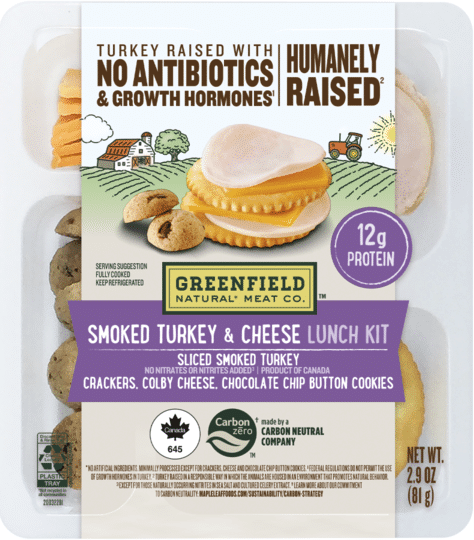
"No Antibiotics & Growth Hormones." "Humanely Raised." The company's own product page adds "no artificial ingredients," "no nitrates or nitrites added," and notes it's part of the first major food company to go carbon neutral. Every one of those claims is real and independently meaningful. None of them has anything to do with heavy metals, because none of them is required to.
The fine print on the package itself spells out exactly what "Natural" is legally certifying: "No artificial ingredients. Minimally processed." That's it. That's the whole claim. It's not us paraphrasing — USDA's Food Safety and Inspection Service requires that exact disclaimer because "natural" on a meat label is a defined, narrow, two-part test: (1) no artificial flavor, color, or chemical preservative, and (2) the product isn't processed in a way that "fundamentally alters" it. It says nothing about how the animal was raised, and nothing about what was in the soil the turkey's feed grew in. For non-meat foods the FDA's informal "natural" policy is even looser: the agency simply "has not objected" to the term when a food has no added color, synthetic substances, or artificial flavor. Neither definition — FDA's or USDA's — ever mentions arsenic, cadmium, or lead, because heavy metals aren't additives. They're contaminants that arrive from the dirt a plant grew in or the feed an animal ate, and "natural" was never built to regulate that axis of food safety at all. It's answering a completely different question than the one you're actually asking when you pick it off the shelf.
Cadmium and lead don't come from a factory — they come from dirt
This isn't a story about a sloppy manufacturer cutting corners. Cadmium and lead are naturally present in soil almost everywhere, at levels that vary by field, and turkey, cheese, wheat crackers, and cocoa all pull trace amounts up through the plant or the animal that ate the plant. A "natural," humanely-raised, no-antibiotics turkey grown on real Canadian farmland is exposed to exactly the same dirt as any other turkey. Being raised without hormones changes nothing about how much cadmium was in the soil that turkey's feed grew in. That's precisely why Greenfield's numbers and Lunchables' numbers land in the same range — the inputs are the same category of food, grown the same way life actually works, tested by the same lab, against the same legal line. "Natural" changes the additive list. It does not change the dirt.
Why none of this is illegal
There is no federal limit on heavy metals in a lunch kit, a cracker, or a slice of turkey — full stop. The FDA does not require manufacturers to test packaged foods for arsenic, cadmium, or lead before they hit shelves, and Prop 65's MADLs are a California-only warning-label trigger, not a national safety ceiling; a product can sit at 80% of that number, sell nationwide, and break no law anywhere. The FDA's Closer to Zero initiative does set specific action levels for heavy metals — but only in food explicitly marketed for infants and toddlers, like rice cereal and pureed pouches. The exact same turkey-and-crackers kit, sold to a six-year-old instead of a one-year-old, falls outside that entire framework. Every number in this article exists because a nonprofit magazine paid for the lab work itself. Nobody was required to publish any of it, and nobody but CR did.
What I'd actually do about it
Don't assume "natural," "no antibiotics," or a celebrity's name on the box says anything about heavy metals. Those claims are true and they answer a real question — just not this one. Keep valuing them for what they actually cover.
Pizza and cheese-forward kits ran hotter than plain turkey-and-crackers, in general. Cadmium concentrates in cocoa and certain cheese-processing steps the same way it does in dark chocolate; three of the four worst cadmium numbers in this table were pizza kits. If you're picking between flavors of the same brand, that's a real lever, not a superstition.
If your kid eats one of these regularly, don't stack it with other known cadmium/lead sources on the same day — dark chocolate, unpeeled sweet potatoes, rice-based snacks, tap water in an older home. The daily limit is a daily total, not a per-product ceiling, and Dr. Rogers' point stands: it doesn't take much else in the same 24 hours to clear it.
Rotate brands and flavors rather than packing the same kit five days a week. None of the 15 products here broke the legal line on a single serving. The exposure that actually matters is the one that repeats.
How to know what's actually in your kid's lunch box
A "Natural" seal, a no-antibiotics badge, and a celebrity's face on the box are three different marketing claims, and none of them is a heavy-metal test result. This is exactly why we built Tallow: scan a barcode and get the ingredient list broken down, additives flagged, and the real published lab results — like the CR numbers above — attached to the product when they exist, so you're checking what was actually measured instead of what the front of the box wants you to assume.
This article reports lab results independently commissioned and published by Consumer Reports in July 2025, for consumer-information purposes. Percent-of-MADL figures are calculated by Tallow from CR's reported micrograms against California's published Proposition 65 Maximum Allowable Dose Levels, and are not part of CR's original published figures. Results reflect the specific products and lots CR tested and are not a legal determination against any company; none of the products discussed exceeded a federal or state safety limit. Sources: Consumer Reports, Lunch Kits test results (PDF), Consumer Reports Lunchly methodology (PDF), The Cool Down, quoting CR's James E. Rogers, Ph.D., California OEHHA, Proposition 65 MADLs, FDA, Use of the Term "Natural" on Food Labeling, USDA FSIS, Meat and Poultry Labeling Terms, FDA, Closer to Zero, and product listing data from Instacart.