
Kitchen detox: 7 toxic cookware swaps that are actually worth making
Teflon pans, black plastic spatulas, plastic cutting boards: what the lab studies found, and the stainless steel, cast iron and wood swaps to make instead.

Emily Harper
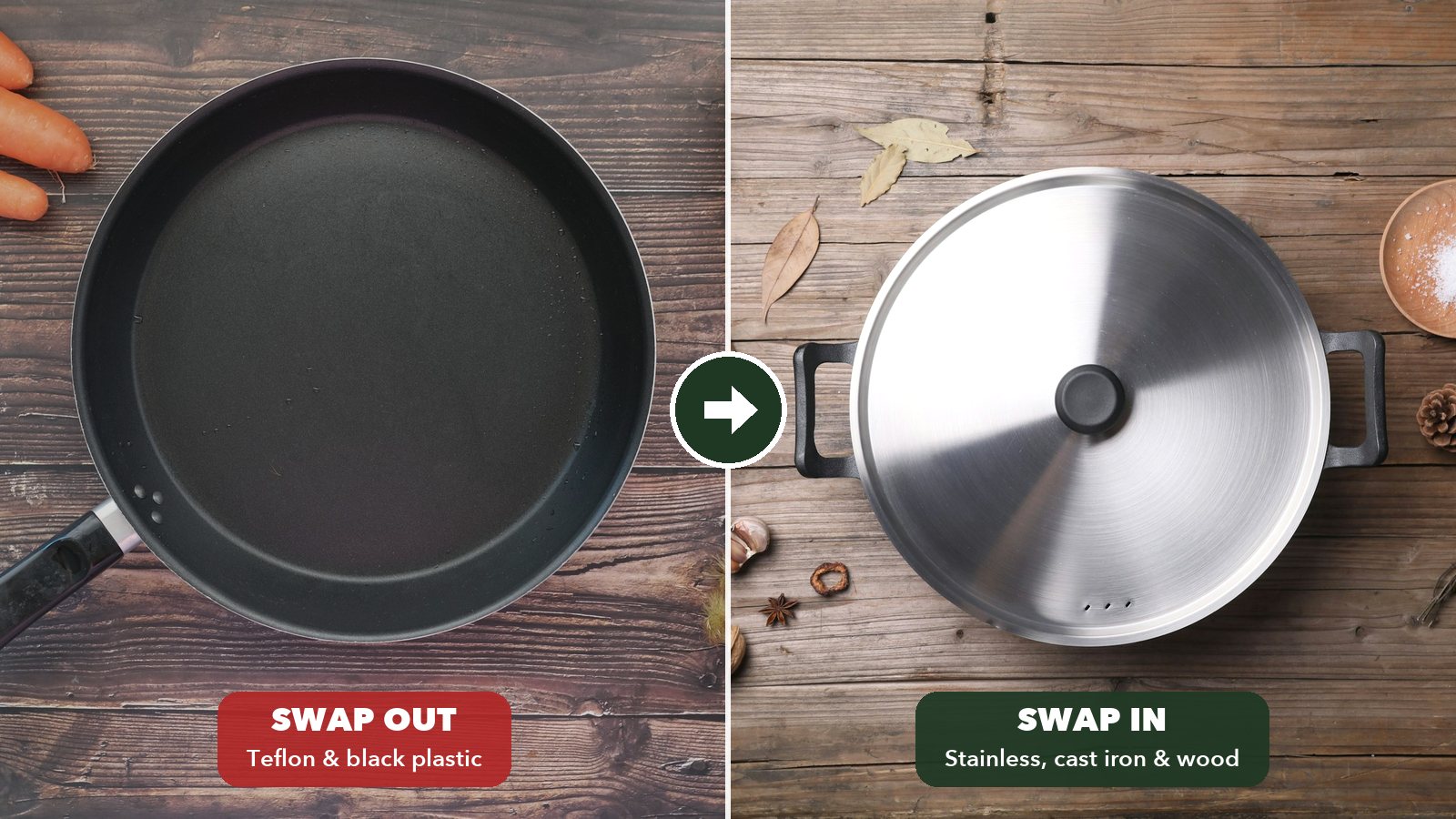
Most of the chemicals people worry about in the kitchen don't come from the food. They come from the stuff touching the food while it's hot: the nonstick pan, the black plastic spatula, the cutting board, the container you microwave leftovers in. Heat and friction are what move material out of a tool and into what you eat.
The good news is that a kitchen detox doesn't mean throwing out everything you own. It's about seven swaps, and most of them cost less than a takeout order. Here's the whole list up front, then the why behind each one.
The kitchen detox swap list
| Swap out | Swap in | Why it's on the list |
|---|---|---|
| Nonstick pans (Teflon/PTFE, "hybrid," most "granite" or "stone" pans) | Stainless steel (tri-ply), cast iron or carbon steel | Scratched coatings shed plastic particles; overheated PTFE gives off fumes |
| Black plastic spatulas and spoons | Solid wood (maple, olive, beech) or stainless steel | Often made from recycled electronics plastic; flame retardants found in kitchen utensils |
| Nylon utensils | Solid wood or stainless steel | Releases plastic oligomers into hot food; German regulators say keep contact short |
| Silicone bakeware and spatulas | Glass, stainless steel or ceramic bakeware; wood for stirring | Every product in a 2024 Health Canada test released siloxanes during baking |
| Plastic cutting boards | Hardwood board (maple, walnut, cherry) | Tens of millions of microplastic particles a year from normal chopping |
| Plastic food containers (especially in the microwave) | Glass or stainless steel containers; reheat on a plate | Microwaving released billions of nanoplastics per square centimeter in 3 minutes |
| "Eco" bamboo-melamine bowls and cups | Stainless steel, ceramic, glass or solid wood | Pulled from EU shelves in 2021 for leaching formaldehyde and melamine |
If you only do one thing this week, do the pans and the black plastic spatula. Those two see the most heat.
1. Nonstick pans: the swap most people search for
"Toxic cookware" is the top search in this whole category on Google, and nonstick is the reason. A few things are worth knowing before you shop.
"PFOA-free" means almost nothing now. PFOA, the chemical behind the original Teflon lawsuits, was phased out of U.S. nonstick manufacturing by 2015. Every pan on the shelf today is PFOA-free. The coating itself is still PTFE, which is a PFAS, and that's the part to pay attention to.
Heat is the first problem. Above roughly 500°F, PTFE starts breaking down and releasing fumes that cause "polymer fume fever," a flu-like illness with chest tightness, coughing and headaches. An empty pan preheating on high can get there faster than people expect. America's Poison Centers logged more than 265 suspected cases in 2023, the most since 2000.
Scratches are the second problem. Researchers at the University of Newcastle and Flinders University found that a single crack in a Teflon coating can release about 9,100 plastic particles, and a badly worn surface around 2.3 million micro- and nanoplastic particles. If your pan has scratches, gray patches or flaking, it's done.
Watch the marketing words. HexClad, one of the most searched cookware brands on Google, paid $2.5 million to settle a class action claiming its "non-toxic" hybrid pans contained PTFE. HexClad denied wrongdoing but agreed to stop calling those pans non-toxic or PFAS-free. "Granite" and "stone" pans are also coated pans; the speckle is the coating, not rock. If a listing only says "PFOA-free" and never says "PTFE-free," assume PTFE.
What to buy instead:
- Stainless steel (tri-ply or clad). The workhorse. It won't flake, can't be scratched into anything harmful, and lasts decades. To keep eggs from sticking, heat the pan first, then add the fat. A drop of water that beads up and skates around means it's hot enough.
- Cast iron. Cheap, nearly indestructible and naturally nonstick once seasoned. Heavy, and better for searing than for long tomato simmers.
- Carbon steel. Seasons like cast iron, but lighter. A favorite for eggs and stir-fries.
- Ceramic-coated pans are PTFE-free and fine as a stopgap. The coating loses its slickness faster than PTFE does, though, so plan on replacing them.
2. Black plastic spatulas and spoons
In 2024, researchers tested 203 black plastic household products and found that black plastic kitchen utensils, takeout containers and toys contained flame retardants, likely because recycled electronics casings were ending up in them. One of the chemicals found, decaBDE, is banned in the U.S.
To be fair: the study's authors later corrected a math error, and the estimated daily intake from a contaminated spatula is under a tenth of the EPA's reference dose, not close to it. That's a lower risk than the first headlines claimed. But a spatula is used in hot oil every day for years, and wood or steel does the same job with none of the question marks.
Swap in: solid hardwood (maple, olive, beech, cherry) for nonstick and everyday stirring, or stainless steel for stainless and cast iron pans.
3. Nylon utensils
Nylon (polyamide) spatulas and spoons are the default "safe for nonstick" option, and most people never think twice about them. Germany's Federal Institute for Risk Assessment (BfR) found that polyamide utensils release oligomers, small plastic fragments left over from manufacturing, into hot food. At high doses, the agency says, those could affect the liver and thyroid. The agency's advice is to keep hot-food contact with nylon as brief as possible, above about 158°F (70°C), and never leave a nylon spoon sitting in a simmering pot.
Swap in: the same wood or stainless steel tools as above.
4. Silicone bakeware and spatulas
Silicone is usually sold as the non-toxic upgrade, so this one surprises people. In 2024, Health Canada scientists tested 25 silicone baking products: muffin molds, loaf pans and baking mats. Every single one contained cyclic siloxanes, leftovers from manufacturing, and those compounds moved into the food and the air during an hour of baking at 350°F. Some siloxanes, such as D4, have been studied for hormone-disrupting effects.
Silicone is still a lot better than old nonstick, and a silicone spatula used for cold batter isn't the issue. The concern is long, hot contact.
Swap in: glass, stainless steel or ceramic bakeware, and unbleached parchment paper instead of silicone baking mats.
5. Plastic cutting boards
Every knife stroke shaves a little off the board. A 2023 study in Environmental Science & Technology estimated that one person chopping on plastic boards produces 14 to 71 million polyethylene microplastics, or up to 79 million polypropylene microplastics, a year. Plastic cutting boards are searched for almost as often as toxic cookware, and "non plastic cutting board" is one of the top related searches.
Wood boards shed particles too, more of them by count in that same study. The difference is that it's wood fiber, not plastic. Stainless steel and titanium boards are trending, but they dull knives fast.
Swap in: a solid hardwood board such as maple, walnut or cherry. Oil it once a month and it will outlast every plastic board you've owned. (We covered a similar hidden source, the plastic burrs inside salt grinders, in an earlier post.)
6. Plastic food containers, especially in the microwave
Researchers at the University of Nebraska-Lincoln microwaved polypropylene and polyethylene containers, both FDA-approved plastics, and measured more than 4 million microplastic and 2 billion nanoplastic particles released per square centimeter of container in three minutes. "Microwave safe" on the label means the container won't warp. It doesn't mean nothing comes off it.
Swap in: glass containers with snap lids (plastic lids are fine if they don't touch hot food), or stainless steel for cold storage and lunches. Reheat on a plate or in a glass dish.
7. "Eco" bamboo-melamine dishes
Those bamboo kids' plates and travel cups look natural, but most are bamboo powder bound with melamine-formaldehyde resin. In 2021, Belgium, the Netherlands and Luxembourg told sellers to pull bamboo-melamine food items from the EU market after repeated tests found formaldehyde and melamine leaching above legal limits, especially with hot food and drinks. They're still easy to buy in the U.S.
Swap in: stainless steel for kids, plus ceramic, glass or solid carved wood.
"Is it actually non-toxic?" Quick answers
These are some of the most common questions people search while shopping for replacements.
- Is stainless steel non-toxic? Yes, for almost everyone. It does release small amounts of nickel and chromium into acidic food, mostly when the pan is new. An Oregon State study found leaching leveled off after about six uses, though it never hit zero. If you have a nickel allergy, use cast iron or carbon steel for long tomato-sauce simmers.
- Is ceramic cookware non-toxic? Ceramic-coated pans are PTFE-free, which is the main win. They just don't last as long. Solid ceramic and enameled cast iron from reputable brands are a good choice.
- Is cast iron safe? Yes. The only thing it adds to your food is a bit of dietary iron.
- Is silicone toxic? Not acutely, but see swap #4. Keep it away from long, high-heat jobs.
- Is titanium cookware better? Many pans sold as "titanium" are nonstick coatings reinforced with titanium particles, so check whether the coating is PTFE. Solid titanium pans exist, but they're rare and pricey.
Where to start
You don't need to replace everything this weekend. In order of how much heat and wear each item gets:
- Any scratched nonstick pan. Replace it with one stainless skillet or one cast iron skillet.
- Black plastic and nylon spatulas. A set of wooden spoons is one of the cheapest upgrades in the house.
- Plastic microwave containers. Start reheating on plates and in glass.
- Plastic cutting board, the next time yours gets fuzzy or grooved.
- Silicone bakeware and melamine dishes, as they wear out.
Now check what's inside the food
Swapping your pans fixes what touches your food. But a lot of the same chemicals are already in the food before it reaches the pan. PFAS shows up in grease-proof packaging (lab tests found a PFAS marker in Kerrygold's old foil butter wrapper). Phthalates come from plastic tubing in food processing (fast food is loaded with them). And microplastics turn up in salt, bottled water and more.
You can't see any of that on a label, which is exactly why we built Tallow. Scan a barcode and Tallow gives the product a 0 to 100 score. It flags seed oils and additives, and it shows independent lab results for heavy metals, PFAS, phthalates and other contaminants when a product has been tested. So after you've cleaned up the cookware, you're not putting the same chemicals back in through what you buy. Download Tallow and scan the first five things in your pantry.
Figures in this post come from the studies, regulators and news reports linked above, current as of October 2026. This is not medical advice.